

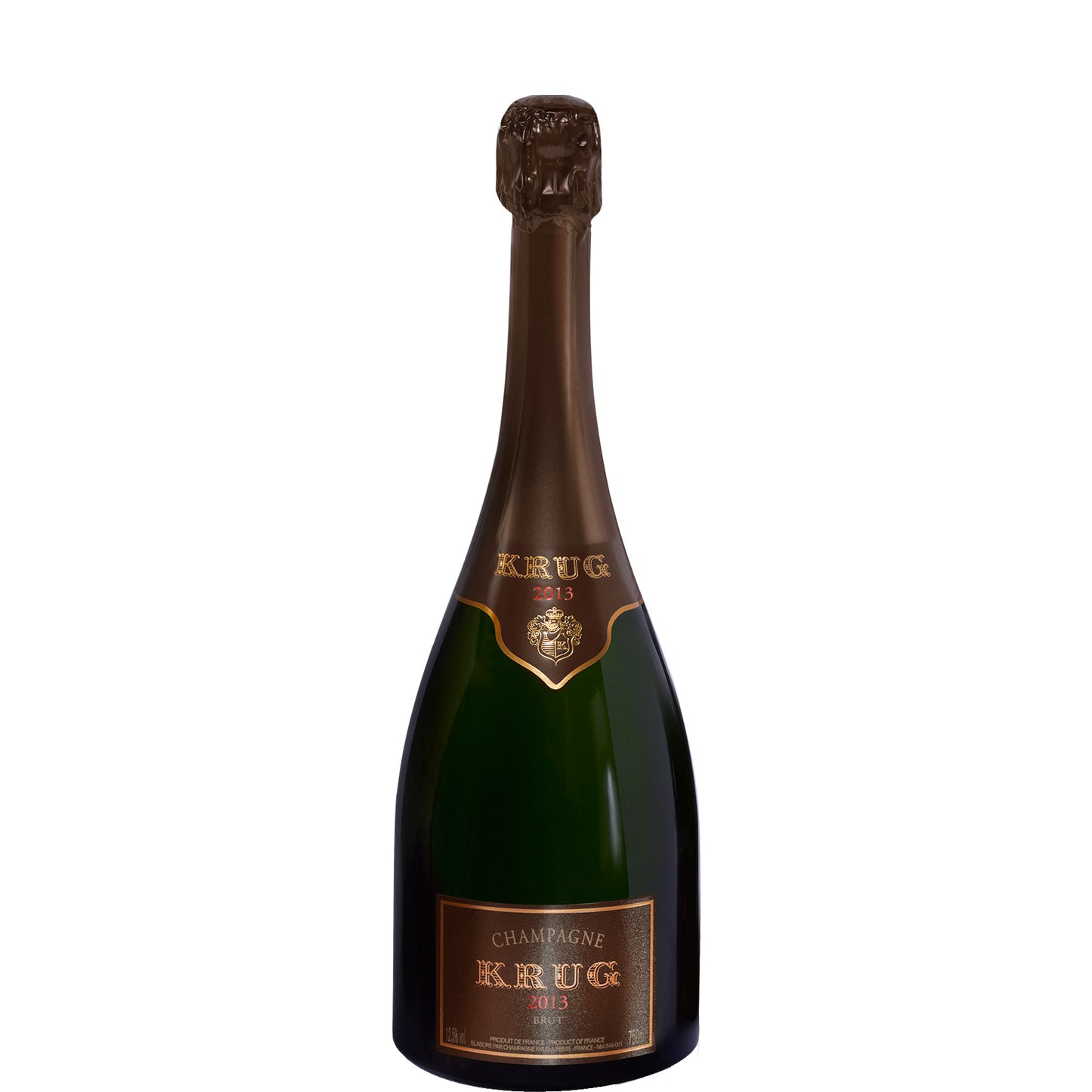
Krug, Vintage Brut, 2013
Krug, Vintage Brut, 2013
- 75cl
- 12%
- White Sparkling
- Pinot Noir, Chardonnay, Pinot Meunier
Couldn't load pickup availability

Optimal drinking window: 2026 - 2053
Krug's Vintage Brut is never a simple declaration of a year; it is Krug's argument for why that year deserved to be bottled at all. The 2013 is a fascinating one: a cool, late harvest that demanded patience and conviction, two things Krug has never been short of. The blend leans on Pinot Noir for structure, with Chardonnay providing the spine of citrus and chalk, and a touch of Meunier rounding things out. Six years on the lees before disgorgement has given it that characteristic Krug density: toasted, layered, unhurried.
To give a sense of quality, 2013 is the joint second-highest rated vintage on Vinous ever, stretching back to 1906, and many of the region’s top producers have already racked up top marks. Krug’s secondary market is famously strong - the House ranked 6th in Liv-Ex's Power 100, the highest of any Champagne - and the 2013 is a real feather in Krug’s cap.
What the critics say:
"The 2013 Vintage is a wild, exotic beauty. Apricot, passion fruit, lemon confit, marzipan, baked apple tart and a kiss of French are all amplified in a dramatic, vivid Champagne that captures all the pedigree of this great vintage. The 2013 is wonderfully complex and dynamic from the very first taste. Time in the glass brings out layers of dimension and captivating nuance. This is a fabulous effort. Krug ID: 124011"
"Originating from an October harvest, Krug’s 2013 Brut has turned out very well, delivering—against the backdrop of the slow, late-ripening season and another high-acid test, qualities rendered all the more evident by the house’s methods—the requisite aromatic plenitude and textural properties. Disgorged in early 2024 with a dosage of five grams per liter, the wine emerges from the glass with a deep bouquet of lemon oil, fresh apricot and quince mingled with nashi pear and brioche crust, complemented by a top note of lightly burnt buttered toast. On the palate, it is medium- to full-bodied, chiseled and racy-fresh, structured around a spine of incisive acidity and chalky extract, concluding with a long, citrus-driven, saline-tinged finish."
"Krug's 2013 will likely prove itself the finest release of this cuvée since the millenium. It's an exquisite example of the restraint of this cool, late-ripening year meeting beautiful fruit selection and patient ageing, yielding a wine full of pristine, crystal-clear and layered flavour. Starting with bright roasted lemon, grapefruit and citric bitters before richer apricot tart and nougat flavours creep in seamlessly, the whole package feels at once svelte, smooth, light-touch and saturated with flavour. It's bright in acidity and coiled-up potential, yet not unapproachably austere even on release. Just when you think it is done, the energy and finish ramps up again with impressive drive and complexity. This is a Krug vintage that feels timeless, bound to keep its integrity even as the flavour profile transforms over time."
Krug sources fruit from across the Champagne region, drawing on over 250 individual plots spanning Grand Cru and Premier Cru villages in the Montagne de Reims, Côte des Blancs, and Vallée de la Marne. The chalk subsoils that run beneath these vineyards are central to what makes Krug wines so mineral and age-worthy — chalk retains moisture without waterlogging, forcing vines to dig deep and concentrate. Each plot is vinified separately in small oak casks, which adds textural richness without obvious oakiness, preserving the character of individual soils and aspects rather than blending it away.
Champagne is the most tightly regulated sparkling wine appellation in the world, confined to a precisely defined area northeast of Paris, with permitted varieties, yields, minimum ageing on the lees, and disgorgement practices all governed by the CIVC. Vintage Champagne must spend a minimum of three years on the lees before release, though houses like Krug routinely exceed this by several years. What distinguishes Champagne from other sparkling wine regions is not simply the method but the chalk — the Crayères beneath the region's greatest vineyards are unique in their capacity to lend wines that saline, electric minerality that no other region has convincingly replicated.
The 2013 vintage caught Champagne in a properly challenging mood. A cold, wet spring delayed budbreak well into May, followed by a summer that couldn't quite decide what it wanted to be — patchy sunshine punctuated by rain that had growers muttering into their morning coffee. Come harvest time in October, the latest picking dates in years meant racing against autumn's chill to gather fruit that had ripened slowly and unevenly across the region.
What emerged from this meteorological muddle was a vintage of surprising charm, though admittedly not one for the history books. The extended hang time gave the grapes a lovely mineral tension, particularly in the Chardonnay, while Pinot Noir struggled more with the conditions but still delivered decent colour and structure. Most houses declared a vintage, albeit in modest quantities, and we find these wines drinking rather well now — they've got that bright, food-friendly acidity that makes you reach for another glass, even if they lack the depth for long cellaring. Drink until 2028.
Explore related wines


-
-
Speak to one of our Wine Gurus
Speak to a Wine GuruWith years of experience, our team can help you with all your wine buying and selling needs