

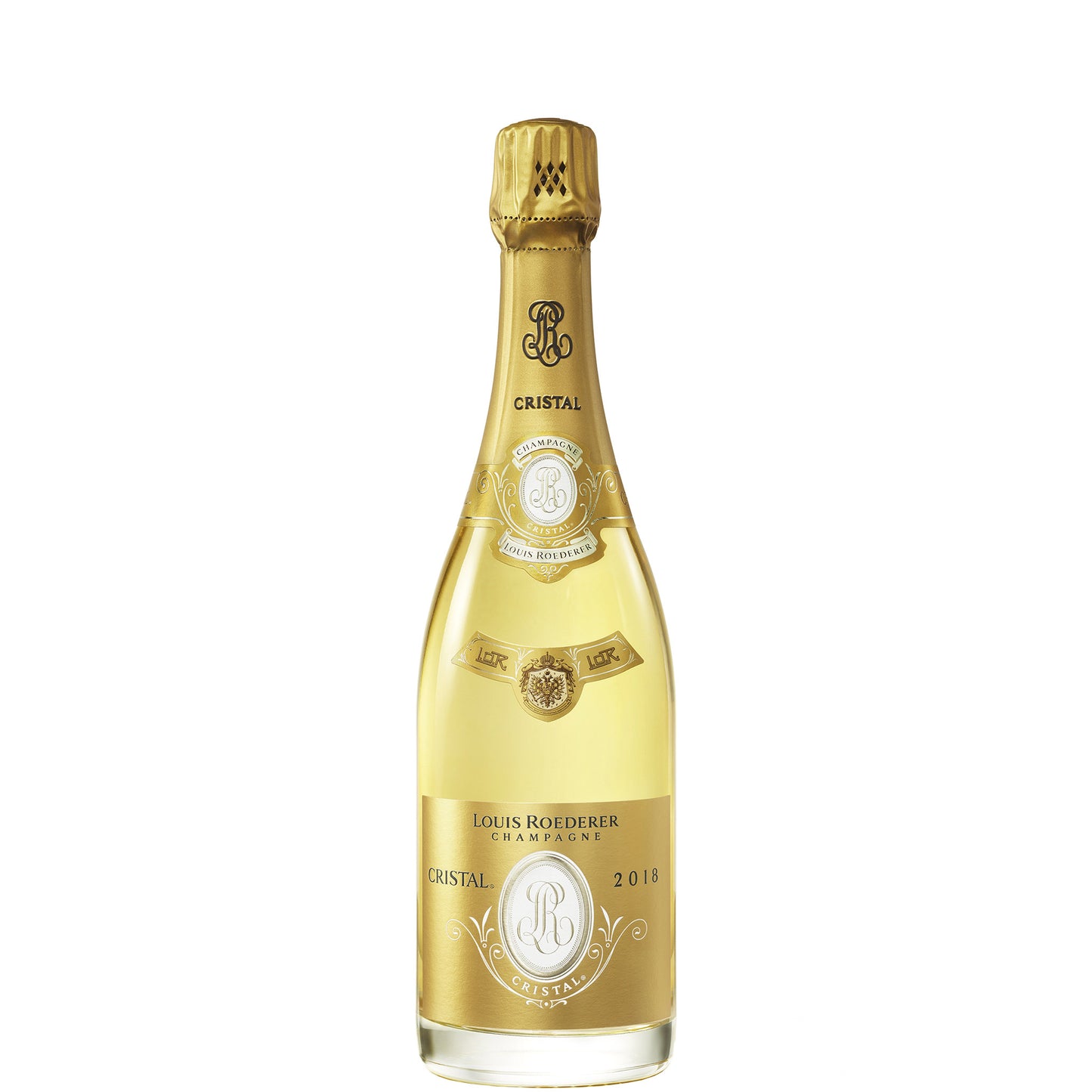
Louis Roederer, Cristal, 2018
Louis Roederer, Cristal, 2018
- 75cl
- 12.5%
- White Sparkling
- Pinot Noir, Chardonnay
- Organic
- Biodynamic
Couldn't load pickup availability

Optimal drinking window: 2026 - 2065
Est. delivery in autumn, 2026
Cristal is one of the most iconic names in Champagne, created in 1876 for Tsar Alexander II, who apparently worried a standard bottle might conceal an assassin's bomb, hence the clear glass. The symbolism has shifted somewhat since then, but the wine's claim to greatness hasn't.
The 2018 vintage was one of Champagne's warmest on record, and in lesser hands that could mean flabbiness or excess. Roederer's response was to pick earlier, preserve acidity, and lean into the freshness that their Cristal vineyards - mostly Pinot Noir and Chardonnay from the Montagne de Reims and Côte des Blancs - naturally offer. The result is a wine of real presence: generous but tightly coiled, rich but never heavy.
What the critics say:
"The 2018 Cristal opens a new chapter for Roederer. The Cristal estate is composed of 45 parcels. In better vintages, most of the 45 parcels are used for the blend. The 2018 vintage brought with it elevated ripeness and generally low acids. Longtime Chef de Caves Jean-Baptiste Lécaillon was forced to cast his gaze wider, to look for parcels that offered a touch of freshness. Lécaillon expanded his palette to 57 parcels. The result is a Cristal unlike any other I have tasted. Orchard fruit, dried flowers, spice, chalk and herbs are some of the many notes that take shape in the glass. Floral and savory overtones are quite distinctive. Lécaillon reduced oak ferments, racked very quickly after fermentation and used all his best Chardonnay lots for Cristal, so much so that there is no Blanc de Blancs. He bottled earlier than normal and chose a crown capsule with a liner that allows less oxygen transfer than the norm here. Taken together, those choices paid off handsomely. In tasting, the 2018 is positively stunning. Its linear energy and brilliance are a bit reminiscent of the 2014, but its flavor profile is completely different from any Cristal I can remember tasting. Dosage is 7 grams per liter."
Cristal is sourced exclusively from Roederer's own grand cru vineyards, principally in Verzenay and Verzy on the Montagne de Reims for Pinot Noir, and Mesnil-sur-Oger and Avize on the Côte des Blancs for Chardonnay. The soils are classic Champagne chalk — Belemnite chalk that drains well, retains just enough moisture through dry summers, and imparts that characteristic saline, mineral edge to the wines. The chalk's reflective properties also moderate temperature, helping the fruit ripen slowly and retain the natural acidity that is the backbone of great Champagne. In warm years like 2018, this cooling effect is not just useful — it's what keeps wines like Cristal honest.
Champagne is the northernmost major wine appellation in France, and its cool marginal climate is what gives the wines their characteristic tension and the base wines their high acidity — essential for the traditional method sparkling wine production the region is defined by. The appellation rules specify that only Chardonnay, Pinot Noir, and Pinot Meunier (alongside a handful of minor varieties) may be used, and all wines must undergo secondary fermentation in bottle. Cristal, as a prestige cuvée, sits above the appellation's general tier — drawn from a single vintage and a specific selection of parcels, with extended lees ageing that goes well beyond the legal minimum. Compared to non-vintage Champagne, vintage Cristal is shaped by a specific year rather than blended for consistency, and the extra time on lees adds layers of autolytic complexity — that brioche and biscuit character — that younger releases simply cannot replicate.
The 2018 growing season in Champagne arrived like a gift after several challenging years. Spring brought warm, dry conditions that encouraged healthy flowering, followed by a summer that stayed remarkably consistent without the extreme heat spikes that can shut down photosynthesis. Rain arrived precisely when the vines needed it in late summer, plumping the grapes without diluting their flavour concentration. The harvest began in late August under sunny skies, with growers reporting some of the healthiest fruit they'd seen in years.
What emerged from this kindness was a vintage that marries immediate charm with serious structure. The Chardonnay shows beautiful purity and tension without the sometimes austere backbone of cooler years, while Pinot Noir developed lovely depth of colour and ripe red fruit character that speaks clearly through the bubbles. We find these wines drinking beautifully now, offering both the fresh exuberance that makes Champagne so joyful and the underlying complexity that will reward patience. Most 2018s will hit their stride over the next five to eight years, though the finest cuvées have the backbone to age gracefully well beyond that.

OUR GROWERS
Louis Roederer
Explore related wines


-
-
Speak to one of our Wine Gurus
Speak to a Wine GuruWith years of experience, our team can help you with all your wine buying and selling needs