

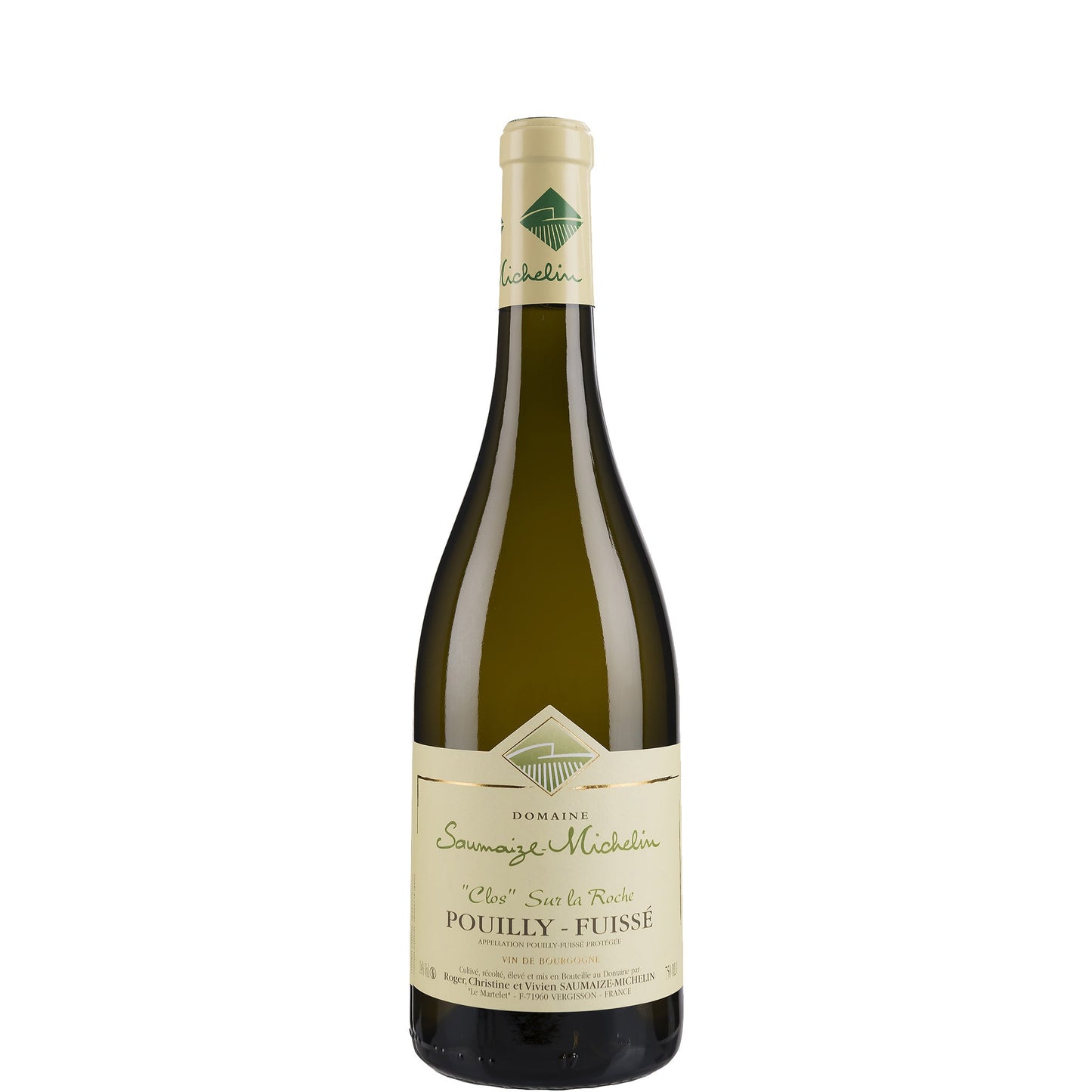
Pouilly-Fuissé Premier Cru 'Sur La Roche', Domaine Saumaize-Michelin, 2024
Pouilly-Fuissé Premier Cru 'Sur La Roche', Domaine Saumaize-Michelin, 2024
- 75cl
- 13.5%
- White Still
- Chardonnay
- Organic
- Biodynamic
Couldn't load pickup availability

Optimal drinking window: 2027 - 2035
Pouilly-Fuissé has had a complicated reputation — too often dismissed as the southern Burgundy you buy when Meursault feels out of reach. The 2023 introduction of premier cru classifications changed that conversation, and 'Sur La Roche' was always going to be one of the sites that justified the fuss. Saumaize-Michelin farm it with the kind of quiet rigour that doesn't need advertising. The rock is right there in the name: this is limestone-driven, saline, and purposefully taut rather than generous.
The 2024 vintage in the Mâconnais was bright and precise, with natural acidity that kept everything honest, and this wine has it in spades; white peach and apple skin, a streak of white pepper, and that distinctive chalky pull on the finish.
Right now, in 2026, this wine is in its tight, primary phase — the fruit is present but the wine hasn't found its full voice yet. By 2027-2028 the acidity should begin to integrate and the limestone minerality will start to emerge more clearly, which is when we think it will hit its stride. The plateau of best drinking likely runs from around 2028 until 2032, when the stone fruit, mineral complexity, and textural interest should all be working in harmony.
What the critics say:
"A fine, complex Pouilly-Fuissé. No overblown fruit or hefty oak here. Subtle, focused and with loads of freshening acidity. Complex with just a background hint of oak adding an extra layer of interest. Has the concentration and purity to age very well."
"Just 50 meters from La Maréchaude, this is markedly different in its expression. The nose is reserved saved some lemony accents, but the palate is rather exotic with strong floral tones alongside endive and celery. Pleasant bitterness (“les bons amers”, as the French say) provide another set of textural modulation. Delicate yet concentrated!"
Tasting Notes
AppearancePale gold with a bright, slightly green-tinged rim — classic young Mâconnais.
NoseWhite peach and Granny Smith apple up front, clean and precise rather than opulent. Give it a moment and you get white pepper, crushed limestone, and something almost waxy — like warm stone after rain. No obvious oak to speak of, which is exactly the point.
PalateMedium-bodied with a tightly wound texture and acidity that drives everything forward. The fruit is there — apple, pear, a suggestion of lemon curd — but what's really talking is the mineral structure, that chalky grip that defines the site. It's not giving much away yet, which is as it should be.
FinishSaline, long, and dry, with a flinty persistence that lingers well after the fruit has stepped back.
Overall impressionA wine that earns its premier cru designation through restraint rather than show — it will be better in two years than it is today.
Food Pairings
In the villages around Vergisson, this kind of wine tends to appear alongside quenelles de brochet — the silky pike dumplings in cream sauce that are a Burgundian institution — or a simple plate of jambon persillé, where the wine's mineral edge cuts beautifully through the richness. Locally caught freshwater fish, gently poached and served with a butter sauce, is another natural match. Further afield on Burgundian tables, you'd find it alongside a plateau de fromages de chèvre, the region's goat's cheeses providing just enough acidity to meet the wine halfway. Escargots in garlic and parsley butter wouldn't be out of place either.
We think this wine would go well with
Serve at 11-12°C — cool enough to preserve the acidity and mineral character, but not so cold that you lose the texture. No need to decant, though giving it fifteen minutes in the glass before drinking will open things up considerably. A good white Burgundy glass with a wider bowl than a standard white wine glass will do it justice, helping to coax the nose without overwhelming it.
The 'Sur La Roche' vineyard sits directly below the great limestone escarpment of Vergisson, with poor, rocky soils dominated by hard limestone and clay over Jurassic bedrock. Vines here have to work for moisture, which concentrates flavour and drives the mineral tension the wine is known for. The altitude and exposure give natural freshness, and the proximity to the rock face creates a distinctive saline, almost flinty character that sets it apart from the richer, more voluptuous vineyards to the south of the appellation.
Pouilly-Fuissé is the flagship white appellation of the Mâconnais, producing Chardonnay from five communes — Fuissé, Solutré-Pouilly, Vergisson, Chaintré, and Prissé. It gained its premier cru classification in 2020, with wines from those sites first appearing in 2023, bringing long-overdue structure to an appellation that had always under-performed its potential on paper. The style leans fuller and more textured than Chablis, but less rich than the Côte de Beaune; at its best, it sits in an intriguing middle ground of stone fruit and mineral precision. Neighbours Pouilly-Loché and Pouilly-Vinzelles share the name but not the reputation.
The 2024 growing season in Burgundy was, frankly, a test of nerve. A wet spring brought significant mildew pressure, and vignerons who stayed sharp in the vineyard — working fast, keeping canopies open, reducing yields where necessary — came out the other side with something worth talking about. Summer brought warmer, drier conditions that helped the fruit recover composure, and harvest arrived broadly on the later side, with growers picking carefully to find phenolic ripeness without sacrificing freshness. Quantity was down across much of the Côte, which concentrates minds as much as it concentrates wine.
What emerged is a vintage that rewards those who put the work in. The Pinots we have tasted carry real precision and translucency — not because they are light, but because the acidity is lively and the fruit unforced. Chardonnays from the Côte de Beaune look particularly promising: taut, mineral, with genuine length. This is not a vintage to panic-open. Most village and premier cru reds want three to five years at minimum, with the better appellations drinking well until 2035 and beyond. The whites are more approachable now, though the best will reward patience too.
FAQs
What does Sur La Roche taste like?
Think taut rather than rich: white peach and apple skin, white pepper, crushed limestone, and a long saline finish. This is a wine defined by its mineral precision rather than fruit generosity, which is exactly what makes it interesting.
When is the best time to drink this wine?
We'd leave it until 2027 at the earliest. It's coiled right now, and the patience will pay off. Best drinking is likely 2028 to 2032, though well-stored bottles should hold until 2035.
Is this worth cellaring?
Yes, genuinely. Premier cru Pouilly-Fuissé from a serious domaine like Saumaize-Michelin has the structure and acidity to reward five to seven years of cellaring. Open it now and you're missing what it's building towards.
What food should I serve with this?
Classic matches are freshwater fish, quenelles de brochet in cream sauce, or jambon persillé. It's also excellent with goat's cheese, simple roast chicken, or anything where a mineral, dry white with real backbone is called for. Avoid heavy, butter-laden dishes that would overwhelm the wine's precision.
How should I serve it?
Serve at around 11-12°C. No need to decant, but give it fifteen minutes in the glass before drinking. Use a wider-bowled white Burgundy glass to get the most out of the nose.
How does this compare to other Pouilly-Fuissé?
The premier cru classification, introduced formally in 2023, marks out specific vineyard sites that consistently outperform the appellation baseline. Sur La Roche is one of those sites — the limestone escarpment directly above the vines gives it a saline, mineral tension that most village-level Pouilly-Fuissé simply doesn't have. Think of it as the appellation finally delivering on its long-overstated promise.
Explore related wines


What are you looking for tonight? Tell me the occasion, a grape, a region — or just try a suggestion below.
Your recommendations will appear here.
-
-
Speak to one of our Wine Gurus
Speak to a Wine GuruWith years of experience, our team can help you with all your wine buying and selling needs