

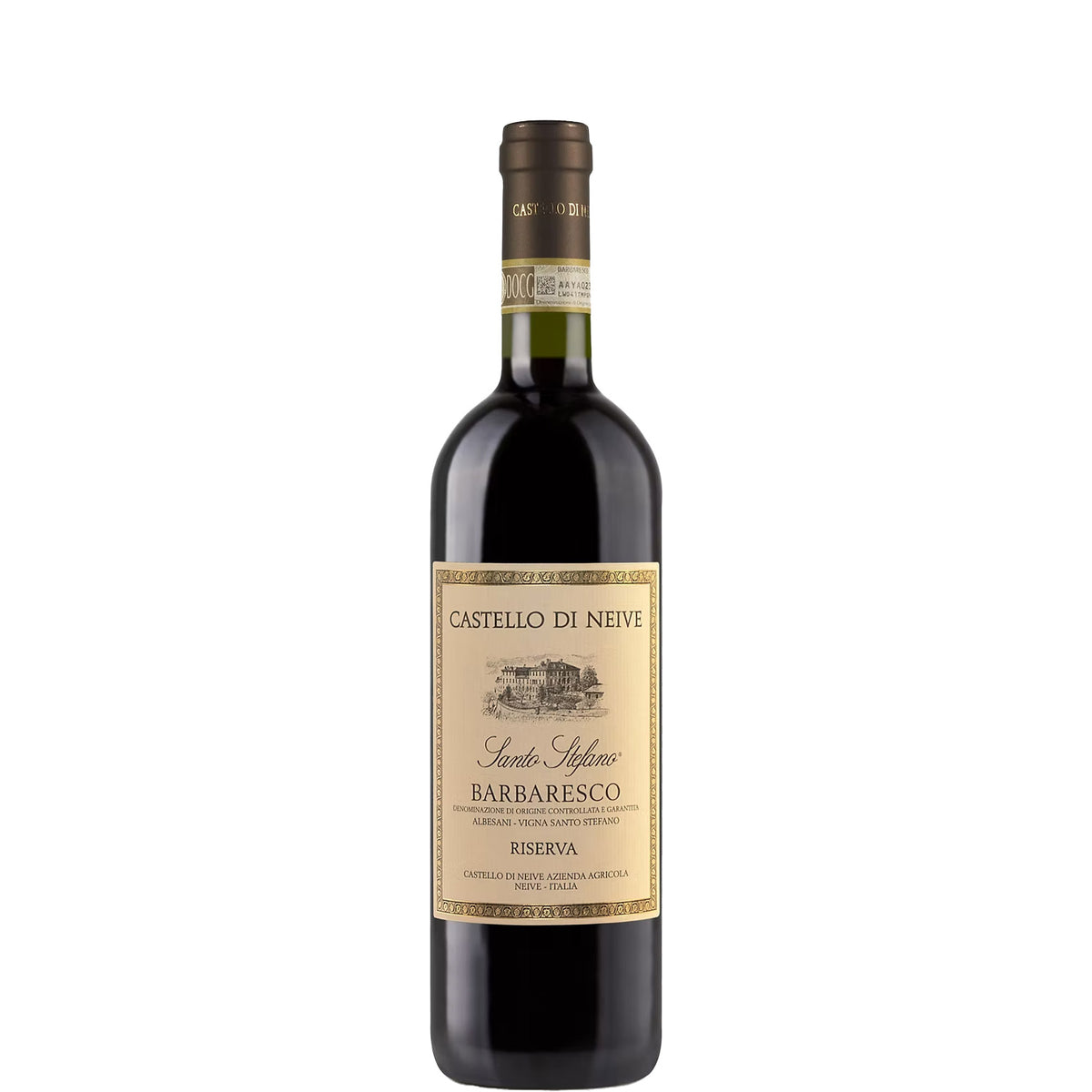
Castello di Neive, Barbaresco Santo Stefano Riserva, 2015
Castello di Neive, Barbaresco Santo Stefano Riserva, 2015
- 75cl
- 14.5%
- Red Still
- Nebbiolo
Couldn't load pickup availability

Optimal drinking window: Now - 2038
Santo Stefano is one of Barbaresco's most celebrated single vineyards, and Castello di Neive has farmed it for decades with the kind of quiet conviction that doesn't need to shout.
This is Nebbiolo in its most aristocratic mood: 2015 gave Piemonte a warm, generous vintage, and the Riserva — aged longer in oak and bottle before release — has had time to pull everything into focus. What you get is a wine of real presence: dried roses, iron, leather, and a palate that's both firm and strikingly fine.
The 2015 vintage gave this wine more fruit weight than the leaner years either side, which means it entered the market with more immediate appeal than a typical Riserva, and at eleven years old, it's in a genuinely good place. The primary fruit is integrating, the tannins are resolving, and the secondary complexity of leather, dried flowers, and earth is coming forward. We'd expect it to reach a plateau of real complexity somewhere around 2028 to 2032, holding there comfortably until 2038 or so before the fruit begins to thin. Beyond 2040, you'd be drinking on faith rather than evidence — though Santo Stefano has surprised people before.
What the critics say:
"Powerful, bright, dark garnet. Opens with notes of leather and saffron, then pickled cherries, some sealing wax and hints of dried mushrooms. Gripping on the palate, lots of ripe plum fruit, hearty tannins with plenty of bite, earthy notes on the finish."
"Underbrush, new leather and balsamic notes of camphor lead the nose along with a whiff of prune. The full-bodied palate shows the heat of the vintage but is still savory, offering dried cherry, marinated prune, licorice and tobacco alongside fine-grained tannins. Drink through 2025 to capture the fruit richness."
Tasting Notes
AppearanceDeep garnet with a brick-tinged rim beginning to show the wine's age gracefully.
NoseDried rose petals, tar, and iron-flecked earth are classic Nebbiolo, but here they're threaded with something finer: a breath of orange peel, dried herbs, and old leather that speaks directly to Santo Stefano's sandy soils. A decade in bottle has compressed and clarified everything.
PalateThe tannins are still present and purposeful but have lost their grip — they're resolving into something closer to velvet than sandpaper. Bright acidity lifts the whole frame, carrying flavours of sour cherry, dried fig, tobacco, and a whisper of dark chocolate through to the mid-palate. 2015's warmth gives it more flesh than a cooler vintage would, without tipping into heaviness.
FinishLong, mineral, and persistent — dried rose and iron linger well after the glass is empty.
Overall impressionA wine that rewards patience but no longer demands it.
Food Pairings
In the Langhe, a wine like this would be poured without ceremony alongside brasato al Barolo — beef braised low and slow in Nebbiolo, which creates an almost circular logic of flavour. Tajarin, the region's egg-rich pasta, topped with a ragù of sausage and porcini is another natural partner, as is a whole roasted guinea fowl with rosemary and garlic. Aged Castelmagno cheese — nutty, dry, slightly bitter — is one of Piemonte's great matches for mature Nebbiolo, and Santo Stefano at this age is no exception. Truffle, if you're feeling flush: white, shaved over practically anything.
We think this wine would go well with
Serve at 17 to 18°C — any warmer and the alcohol starts to dominate, any cooler and the nose closes in on itself. Decant for at least an hour, ideally two; at eleven years old the wine opens up significantly with air, and the tannins soften noticeably. A large Burgundy-style bowl gives the aromatics room to unfurl and does justice to the wine's perfume as much as its structure.
The Santo Stefano vineyard sits on the classic Tortonian-era Helvetian soils of Neive: compact Lamole-type marl and limestone with a high proportion of sand, which gives Barbaresco from this site its characteristic finesse and perfume rather than the more muscular weight found in some other crus. The south to south-west aspect ensures excellent ripening even in cooler years, while the altitude — around 200 to 300 metres — preserves the acidity that keeps these wines alive for decades. The combination produces Nebbiolo of striking aromatic lift and refined tannin structure.
Barbaresco DOCG sits immediately east of Barolo, separated by the town of Alba, and shares Barolo's sole grape — Nebbiolo — but tends to produce wines that are slightly earlier-maturing and more perfumed, if no less serious. The denomination covers the communes of Barbaresco, Neive, Treiso, and a small part of Alba, with Riserva status requiring a minimum of four years' ageing, at least nine months of which must be in oak. Compared to Barolo, Barbaresco is often described as the more feminine expression of Nebbiolo, though that framing undersells just how structured and long-lived the great examples can be.
The 2015 vintage in Piemonte arrived like a gift after the challenges of recent years. A warm, dry growing season delivered perfect ripening conditions, with September's cool nights preserving the freshness that makes these wines so compelling. The harvest came early but unhurried, allowing producers to pick at optimal ripeness without the usual autumn anxiety about weather turning.
What emerged were wines of immediate charm and underlying substance. The Nebbiolos show ripe fruit and approachable tannins whilst retaining that iron-and-roses character that defines great Barolo and Barbaresco. Barbera positively sings with vibrant acidity balanced by generous fruit, and even the Dolcettos have extra depth and staying power. Most 2015s are drinking beautifully now, offering pleasure whilst developing the secondary flavours that will carry the best bottles comfortably until 2030.
FAQs
What does this wine taste like?
Think dried roses, iron, tar, and sour cherry with a palate that's firm but increasingly silky. The 2015 vintage adds a touch more flesh and ripeness than cooler years, giving it genuine generosity alongside the classic Nebbiolo structure. The finish is long and mineral.
When should I drink this wine?
It's already in a good place and worth opening now with something substantial to eat. That said, the best is still coming — we'd expect it to hit a real peak of complexity between 2028 and 2032, and it should hold well until at least 2038.
Does it need decanting?
Yes, definitely. Give it at least an hour in a decanter, ideally two. At eleven years old it opens up significantly with air, the tannins soften, and the nose becomes much more expressive. Don't skip this step.
What food should I serve with it?
Braised beef or lamb are natural partners — anything slow-cooked and richly savoury. Aged Castelmagno or Parmigiano work brilliantly if you're going the cheese route. Avoid anything too delicate; this wine wants something with substance on the plate.
Is this worth cellaring further?
Yes, if you can resist it. The wine has plenty of life ahead — another five to ten years will bring greater complexity and depth. Buy a case, drink one now to check in, and leave the rest alone.
How does Santo Stefano compare to other Barbaresco crus?
Santo Stefano is widely considered one of the denomination's finest single vineyards, known for producing Barbaresco of exceptional finesse and perfume rather than sheer power. Castello di Neive holds a monopole on the vineyard, meaning this is the only producer bottling it — which makes it rarer and more site-specific than most Langhe offerings at any price.


What are you looking for tonight? Tell me the occasion, a grape, a region — or just try a suggestion below.
Your recommendations will appear here.
-
-
Speak to one of our Wine Gurus
Speak to a Wine GuruWith years of experience, our team can help you with all your wine buying and selling needs