

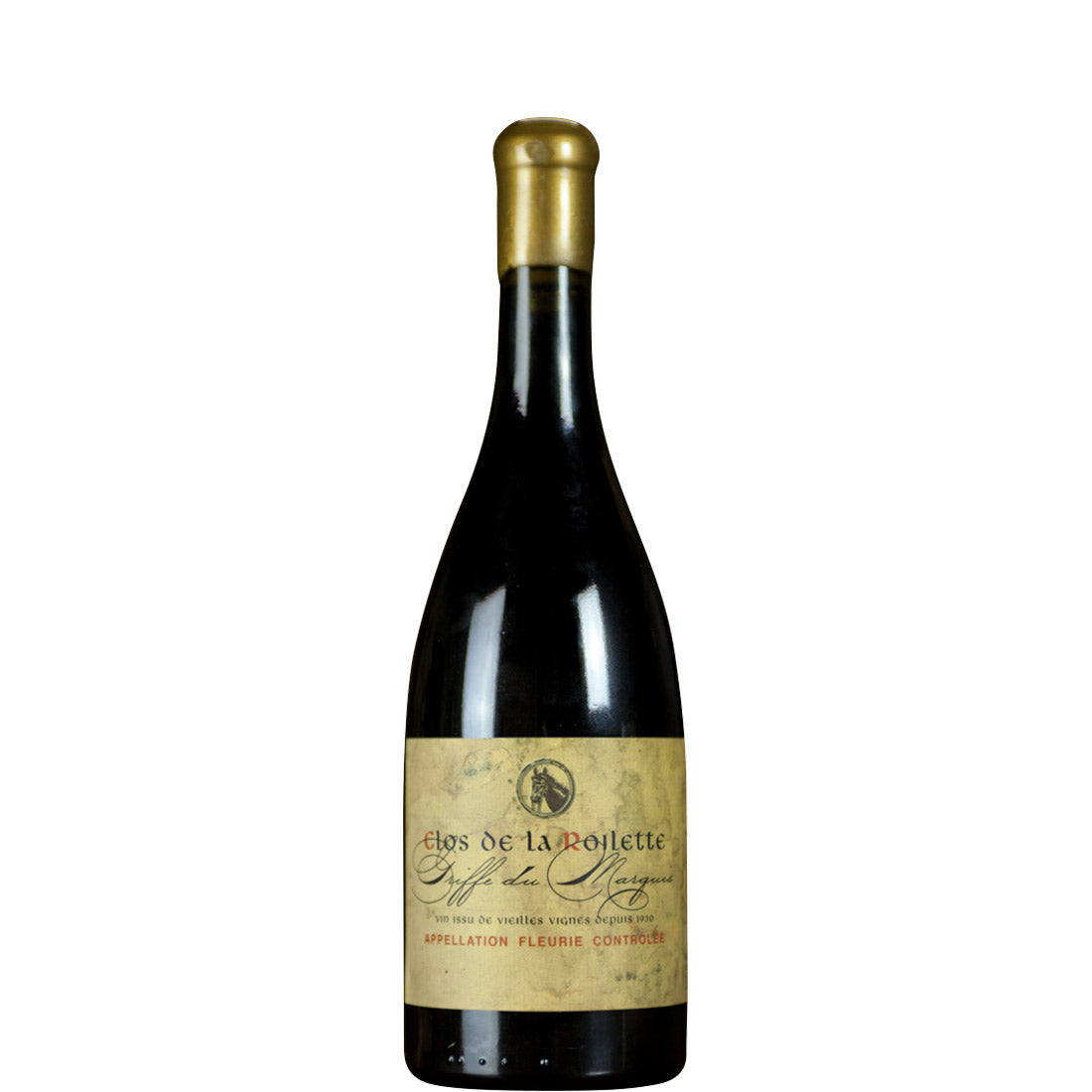
Clos De La Roilette Fleurie Griffe Du Marquis, Domaine Coudert, 2021
Clos De La Roilette Fleurie Griffe Du Marquis, Domaine Coudert, 2021
- 75cl
- 13%
- Red Still
- Gamay
Couldn't load pickup availability

Optimal drinking window: 2026 - 2038
Clos de la Roilette Griffe du Marquis is not the Fleurie you pour on a Tuesday without thinking. Alain Coudert makes this from two parcels of 80-year-old vines on the clay and granite boundary with Moulin-à-Vent, and ages it for twelve months in used Burgundy barrels. The result is Gamay with real structure: dark plum, violet, a touch of iron-rich earth, and tannins that mean business.
The name is a family joke turned label — Alain's mother was nicknamed "la Marquise" by a family friend, and it stuck. Only around 3,000 bottles are made each year.
In 2026, the 2021 is still in its primary phase — the fruit is vivid and the tannins are present enough to remind you this wine has unfinished business. Between 2027 and 2030, expect the dark fruit to soften and integrate with the oak spice, and secondary notes of leather, dried herbs, and earthy complexity to start emerging in earnest. The peak is likely somewhere in the 2030-2034 window, when fruit, structure, and secondary character should all be in conversation with each other. The 2009 tasted at lunch with Alain in 2024 was still going strong — so while we suggest drinking until 2038, it may well surprise you beyond that if cellared carefully.
What the critics say:
"Clear fresh mid purple, really classy nose despite a fractional pyrazine. Lovely suavity to the fruit which covers the structure and hides the pyrazine. The cherry side of strawberry, and the wood has really helped. Chapeau for 2021! Drink from 2024-2026. *4/5*"
Tasting Notes
AppearanceDeep ruby with a purple core and a clear, bright rim — still very youthful for a 2021.
NoseDark plum and blackberry at the front, then violet and dried rose petal rising through. There is a mineral, almost iron-tinged edge beneath it — earthy and a little brooding — and the oak sits quietly in the background, adding spice without announcing itself.
PalateFuller than the nose promises, with real grip from those clay-grown vines — firm, fine-grained tannins and a bright vein of acidity that keeps everything honest. Dark berry fruit, a hint of black olive, and a stony mineral quality that nudges this well outside conventional Fleurie territory.
FinishLong, spicy, and mineral, with the tannins holding their shape to the very end.
Overall impressionSerious Gamay that is only just beginning to show what it intends to become.
Food Pairings
In the Lyon bouchons just down the road, a wine like this would be poured alongside andouillette sausage or pot-au-feu without a second thought — Beaujolais cru and offal-rich Lyonnaise cooking are one of France's great unsung pairings. A côte de boeuf grilled over vine cuttings would be the obvious Sunday answer, or a roast guinea fowl with lardons and thyme. The structure here also makes it a natural match for aged Comté or Morbier — the saltiness and nuttiness of those cheeses play beautifully against the wine's earthy spice. If you want something simpler, braised lentils with smoked duck would not disappoint.
We think this wine would go well with
Serve at 15-16°C — cool enough to keep the freshness alive, but not so cold that the tannins clamp shut. Decant for at least 45 minutes in 2026; in a couple of years that may be less necessary. A Burgundy-shaped glass gives the nose room to open up, and this wine genuinely rewards giving it that space.
The two parcels that make up Griffe du Marquis sit on the southern edge of Fleurie, close to the Moulin-à-Vent border, where the soils shift from the lighter granitic sands typical of Fleurie to a heavier mix of clay and decomposed granite. This gives the wine more grip and structure than most Fleurie, and the 80-year-old vines dig deep enough to pull out a mineral complexity that younger plantings simply cannot match. The elevation and exposure help retain freshness and acidity even in warmer years, keeping the wine balanced rather than heavy.
Fleurie is one of the ten Beaujolais crus — the top tier of the region — and has a reputation for producing the most perfumed, silky expressions of Gamay. It sits in the heart of the cru zone, flanked by Moulin-à-Vent to the north and Morgon to the east, and its pink granite soils typically produce wines that are lighter and more floral than its neighbours. However, parcels on the Moulin-à-Vent border, where soils are heavier and manganese content rises, can yield wines of considerably more weight and longevity — exactly the conditions Coudert exploits for Griffe du Marquis.
FAQs
What does Griffe du Marquis taste like?
Think dark plum, violet, and earthy spice, with fine tannins and a mineral edge that sets it apart from most Fleurie. The oak is there but it doesn't dominate — it adds texture and depth without getting in the way of the fruit.
Is this typical Fleurie?
Not really — and that is the point. Most Fleurie is lighter, more floral, and made for early drinking. Griffe du Marquis is barrel-aged and sourced from old vines on heavier clay and granite soils bordering Moulin-à-Vent, which gives it real structure and ageing potential. It is Fleurie with serious intentions.
When should I drink this?
It is approachable now if you give it a good 45 minutes in a decanter, but it will reward patience. We think the sweet spot is 2028 to 2034, with further potential until 2038. A vertical tasting of the 2009 with winemaker Alain Coudert showed the wine still vibrant and complex — so cellaring is very much worthwhile here.
What food should I serve with this?
Something with a bit of richness and savouriness to match the wine's structure. Braised beef, roast guinea fowl, a côte de boeuf, or classic Lyonnaise dishes like pot-au-feu all work well. Aged Comté or Morbier are excellent if you want to go the cheese route.
How should I serve it?
At around 15-16°C and decanted for at least 45 minutes. Use a Burgundy glass to give the nose room to breathe. Avoid serving it too cold — that will close the wine down rather than open it up.
How many bottles are made each year?
Around 3,000 — just 12 barrels' worth. It is a genuinely small production from two parcels of 80-year-old vines, which is part of why it has the depth and concentration it does.

OUR GROWERS
Domaine Coudert
Explore related wines


What are you looking for tonight? Tell me the occasion, a grape, a region — or just try a suggestion below.
Your recommendations will appear here.
-
-
Speak to one of our Wine Gurus
Speak to a Wine GuruWith years of experience, our team can help you with all your wine buying and selling needs