

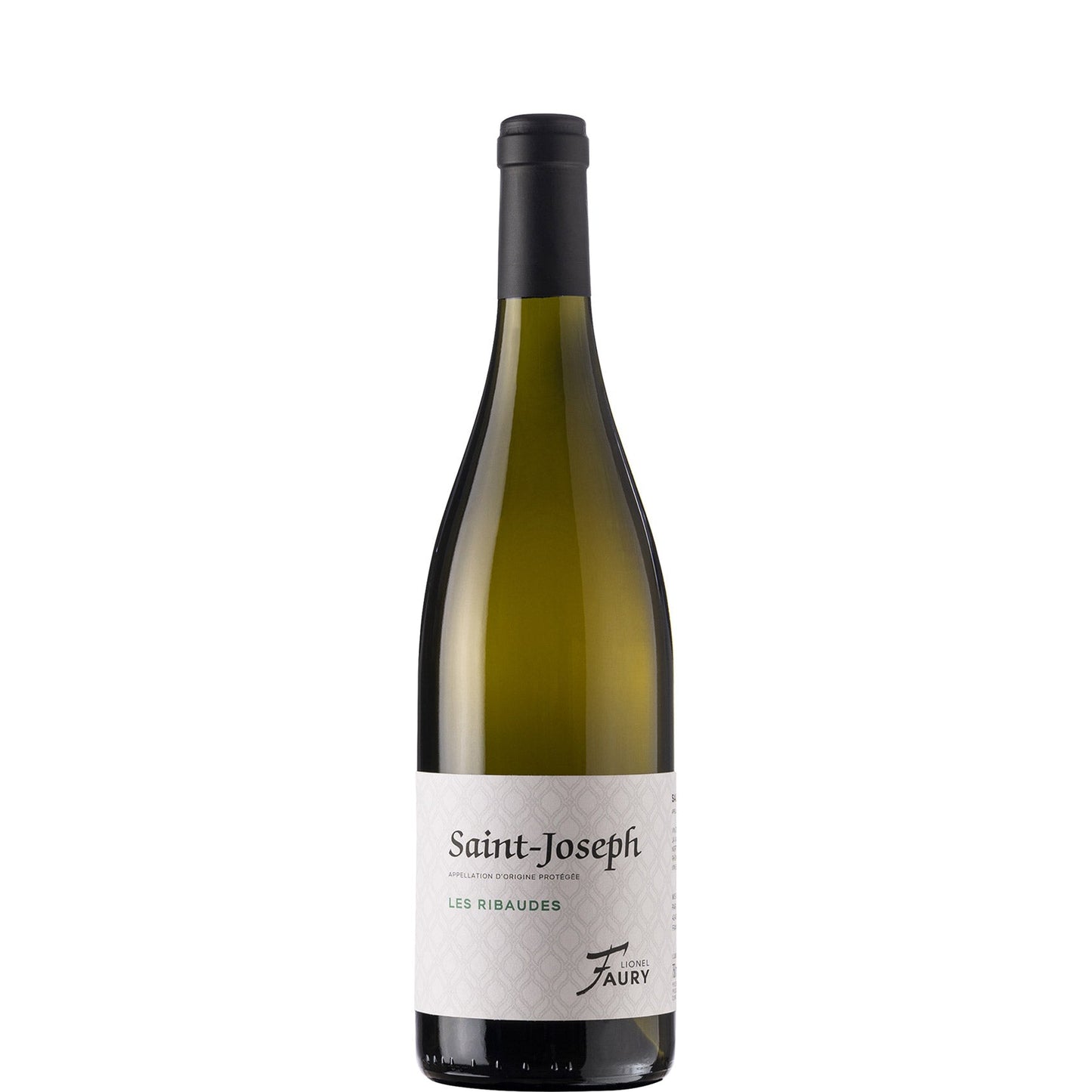
Domaine Lionel Faury, Saint-Joseph Blanc, Les Ribaudes, 2023
Domaine Lionel Faury, Saint-Joseph Blanc, Les Ribaudes, 2023
- 75cl
- 13.5%
- White Still
- Marsanne, Roussanne
Couldn't load pickup availability

Optimal drinking window: 2026 - 2033
Lionel Faury's Les Ribaudes is one of the stars of Saint-Joseph Blanc — a wine that reminds you why the northern Rhône does white as well as any region in France. Made primarily from Marsanne with some Roussanne, it comes from a single lieu-dit on the granitic slopes above Chavanay, and it has that distinctive character the appellation does so well: generous without being fat, mineral without being austere, and built with enough freshness to keep you reaching for the glass.
The 2023 vintage brings lovely ripeness from a warm, dry summer, but Les Ribaudes holds its tension admirably. White stone fruit, blossom, and a streak of saline minerality carry through a long, focused finish. This is a wine that will reward another year or two of patience but is already very good company.
Right now, the 2023 is in an attractive early phase where the fruit is vivid and the mineral freshness is most obvious. Over the next two to three years, the Marsanne's characteristic waxy, lanolin quality will begin to emerge more prominently, and the wine will knit together into something richer and more complex. By around 2028-2029, it should be at its most complete, with primary fruit, developed texture, and secondary nutty, honeyed notes all in balance. After 2031, it may begin to tip toward a more oxidative, nutty style that some love but others find less immediate. Drink by 2033 for the fullest picture.
Tasting Notes
AppearancePale gold with a bright, lively rim and excellent clarity.
NoseWhite peach and apricot blossom up front, followed by crushed granite and a faint waxiness that signals the Marsanne. There is a freshness here that belies the warm vintage, with a lifted quality that keeps things elegant rather than opulent.
PalateMedium-full bodied with real textural presence — that slightly oily, glyceric quality Marsanne delivers at its best — balanced by lively acidity and a saline, mineral thread. White stone fruit and a touch of almond skin give way to a focused, clean mid-palate that feels precise rather than showy.
FinishLong and mineral, with a stony, almost chalky persistence that lingers well after the fruit fades.
Overall impressionA serious northern Rhône white that earns its price without making a fuss about it.
Food Pairings
Along the northern Rhône, a wine like this would naturally accompany quenelles de brochet — the pike dumplings in a rich Nantua sauce that are a Lyon-region staple and a perfect match for Marsanne's weight and texture. Gratin dauphinois, that deceptively simple potato dish enriched with cream and garlic, is another natural partner. Freshwater fish from the Rhône itself, simply cooked with butter and herbs, would let the wine's mineral character shine. Further afield, the Ardèche tradition of charcuterie with local cheeses like Picodon — a small, sharp goat's cheese — works beautifully with the wine's saline edge.
We think this wine would go well with
Serve at around 11-12°C — cool enough to preserve freshness but not so cold that you lose the textural complexity. No need to decant, but give it ten minutes in the glass to open up, particularly if you are drinking it young. A wide-bowled white Burgundy glass suits Marsanne well, giving the aromatic richness room to breathe without dissipating the wine's precision.
The Les Ribaudes vineyard sits on steep granitic terraces above the village of Chavanay, where thin, sandy soils over decomposed granite force the vines to dig deep and deliver wines of real mineral character. The altitude and aspect provide natural freshness, even in warm vintages, while the granite imparts that clean, stony quality that separates northern Rhône whites from their richer southern cousins. Drainage is excellent, and yields are naturally constrained by the poor soils.
Saint-Joseph is one of the northern Rhône's most stretched appellations, running some 60 kilometres along the right bank of the river, from Chavanay in the north down to Guilherand-Granges in the south. For whites, only Marsanne and Roussanne are permitted, and the best examples — particularly from the granitic northern end near Chavanay and Mauves — can rival Hermitage Blanc for complexity and age-worthiness at a fraction of the price. The appellation has expanded considerably since the 1960s, which means quality varies widely; the single-vineyard wines from growers like Faury represent its best face.
The 2023 growing season in the Rhône started promisingly with a mild winter and early budbreak, but spring brought its challenges with late frosts affecting some vineyards, particularly in the north. Summer delivered the heat we expect here, though without the punishing extremes that can shut down photosynthesis entirely. What saved the vintage was September's cooling temperatures and occasional rain, allowing the grapes to retain freshness while completing their ripening cycle. Harvest began earlier than usual but proceeded at a measured pace, giving producers flexibility to pick at optimal moments.
The result is a vintage that captures the Rhône's sunny disposition without the overwrought power that can make these wines feel heavy-handed. Syrah from the northern appellations shows particular promise, combining the grape's natural spice and dark fruit intensity with surprising lift and precision. In the south, Grenache-based blends benefit from that late-season freshness, offering immediate charm whilst maintaining enough structure for proper ageing. Most 2023s are drinking beautifully now and will continue to develop until 2035, making this a vintage that rewards both early drinking and patient cellaring.
FAQs
What does Les Ribaudes taste like?
White peach, apricot blossom, and a waxiness that is classically Marsanne, all underpinned by a stony, saline minerality from the granitic soils. It has real textural presence on the palate without ever feeling heavy.
When is the best time to drink this wine?
It is drinking well now, but another one to two years will allow it to integrate and develop more complexity. The sweet spot is roughly 2027 to 2030, though it should hold comfortably until 2033.
What food should I serve with this wine?
It loves rich, creamy dishes — think quenelles de brochet, gratin dauphinois, or simply roasted white fish with butter. Strong-flavoured cheeses like Picodon also work well with the wine's saline edge.
Does it need decanting?
No decanting needed. Just serve it cool — around 11-12°C — and let it breathe in a wide-bowled glass for ten minutes or so.
How does this compare to other Saint-Joseph Blancs?
Les Ribaudes sits at the top of the appellation in terms of site quality and winemaking precision. Many Saint-Joseph Blancs lean toward the richer, rounder end of the spectrum; this one has genuine mineral tension that sets it apart and gives it real ageing potential.
Is this wine worth cellaring?
Yes, within reason. Marsanne-based whites from good northern Rhône sites can age well for a decade, and this is no exception. Keep it until 2028 or so for its most complete expression, but it is already very rewarding to drink now.


What are you looking for tonight? Tell me the occasion, a grape, a region — or just try a suggestion below.
Your recommendations will appear here.
-
-
Speak to one of our Wine Gurus
Speak to a Wine GuruWith years of experience, our team can help you with all your wine buying and selling needs