

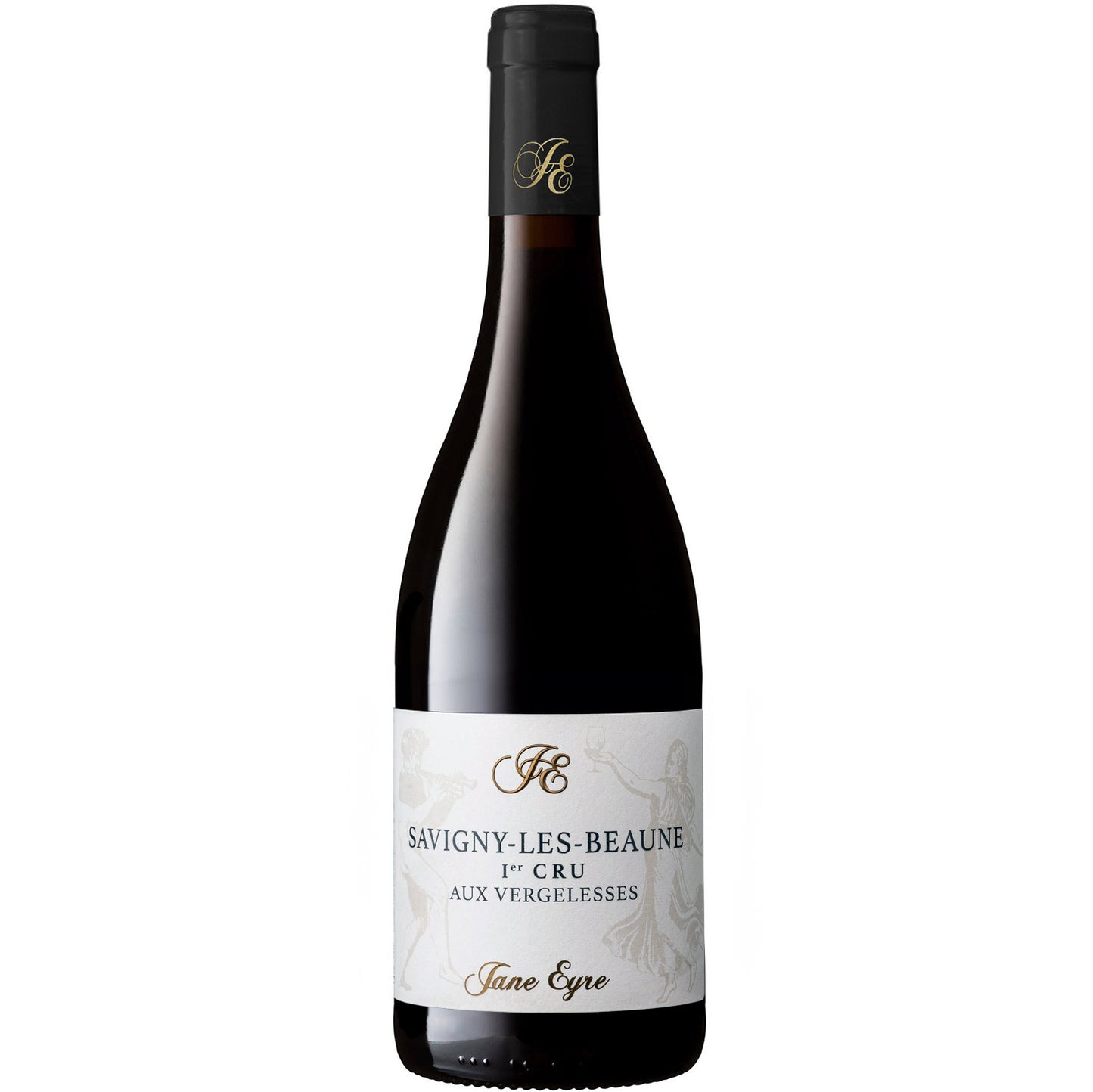
Savigny-lès-Beaune Premier Cru 'Aux Vergelesses', Jane Eyre, 2024 - Magnum
Savigny-lès-Beaune Premier Cru 'Aux Vergelesses', Jane Eyre, 2024 - Magnum
- 150cl
- 13%
- Red Still
- Pinot Noir
Couldn't load pickup availability

Optimal drinking window: 2028 - 2038
"Jane’s longest-standing contract. Always pale, even more so in 2024. Strawberry fruit, a hint of smoke, and a savoury edge on the finish. Restrained oak influence and a delicate, savoury profile."
Stewart Pryce, Honest Grapes Wine Club Manager
2024 could hardly suit Jane Eyre better. A cool, rain-affected year with low natural alcohols and sharply reduced volumes, it demanded obsessive sorting and restraint in the cellar. Jane delivered both. Sorting varied dramatically by site, with some parcels requiring extraordinary attention, but the results are wines of clarity, finesse, and unmistakable origin.
Les Vergelesses is one of the finest premier cru sites in Savigny-lès-Beaune, sitting on the hill that divides Savigny from Pernand-Vergelesses and sharing the same iron-rich, limestone-laced soils that give the best wines here their unmistakable combination of red-fruited charm and stony grip.
This is Savigny at its most serious without losing any of its approachability. We would give it until 2028 before pulling the cork.
Right now, the 2024 is still in its early, primary phase — pale-fruited, nervy, and a little closed, like a sentence that hasn't quite finished yet. From around 2028 onwards, as that strawberry and smoke begin to knit with the stony, iron-edged structure of Vergelesses, the wine will start to reveal its real personality. Through the early 2030s it should hit a confident plateau, with the savoury grip softening just enough to let the fruit shine without losing any of its Savigny character. Being a magnum, the evolution will be slower and more graceful than a standard bottle, so there is no rush whatsoever. We would not expect any meaningful decline before 2036 at the earliest, and that is being conservative.
What the critics say:
Tasting Notes
AppearanceClear, mid-ruby with a clean garnet rim — no signs of weight, everything elegant.
NoseRed cherry and a little wild strawberry up front, then something more mineral and earthy creeps in — iron filings, dried herbs, a faint suggestion of forest floor. It's restrained rather than shy, the kind of nose that opens up with twenty minutes in the glass.
PalateFirm, fine-grained tannins and bright acidity give this real structure without any harshness. The fruit is precise rather than generous — red cherry and pomegranate, with a chalky mineral quality on the mid-palate that feels very much like the limestone beneath the vines. There's a latent depth here that the 2024 vintage's freshness keeps in check for now.
FinishLong and mineral, with dried cherry skin and a faint iron note that lingers satisfyingly.
Overall impressionA wine that hasn't fully revealed itself yet, and is better for it.
Food Pairings
In Burgundy, this kind of wine ends up on the table alongside dishes that respect it rather than compete with it. A poulet de Bresse roasted simply with tarragon and butter is the classic — the acidity cuts through the fat and the earthiness echoes the wine. Slow-braised rabbit with mustard and lardons is another natural match. Locally, you'd also see it with Époisses, though the cheese is pungent enough to demand a wine with some structure to stand up to it. A charcuterie board heavy on jambon persillé and Morteau sausage works beautifully on a more casual evening.
We think this wine would go well with
Serve at around 15-16°C — cooler than many expect for red Burgundy, but it keeps the acidity lively and the mineral character sharp. Being a young 2024 in magnum, a 30-minute decant will help open the nose and soften the tannins slightly, though it doesn't need aggressive aeration. A large-bowled Burgundy glass — Zalto Burgundy or Riedel Sommeliers equivalent — will give the aromatics room to develop. Don't rush it.
Aux Vergelesses sits on the north-facing slope above Savigny-lès-Beaune, at the point where the hill meets the boundary with Pernand-Vergelesses. The soils are limestone-rich with reddish-brown clay over a Bajocian limestone bedrock, which gives the wines their characteristic mineral firmness. The elevation and aspect make this one of the cooler premier cru sites in the commune, slowing ripening and building the kind of structure you don't find in the more southerly Savigny lieux-dits. That cooler microclimate is precisely what makes Vergelesses age so well.
Savigny-lès-Beaune sits in a lateral valley cutting into the Côte de Beaune, easily overlooked between the glamour of Beaune to the south and Pernand-Vergelesses to the north. The village has 22 premier cru vineyards, split broadly between two distinct sides of the valley: the Vergelesses side to the north, which tends towards structure and minerality, and the Marconnets side to the south, which leans softer and more immediately approachable. The AOC rules permit both red and white, though red Pinot Noir dominates. Savigny-lès-Beaune has historically punched below its weight in prestige relative to quality — which for buyers means the prices remain far more civilised than the wines deserve.
The 2024 growing season in Burgundy was, frankly, a test of nerve. A wet spring brought significant mildew pressure, and vignerons who stayed sharp in the vineyard — working fast, keeping canopies open, reducing yields where necessary — came out the other side with something worth talking about. Summer brought warmer, drier conditions that helped the fruit recover composure, and harvest arrived broadly on the later side, with growers picking carefully to find phenolic ripeness without sacrificing freshness. Quantity was down across much of the Côte, which concentrates minds as much as it concentrates wine.
What emerged is a vintage that rewards those who put the work in. The Pinots we have tasted carry real precision and translucency — not because they are light, but because the acidity is lively and the fruit unforced. Chardonnays from the Côte de Beaune look particularly promising: taut, mineral, with genuine length. This is not a vintage to panic-open. Most village and premier cru reds want three to five years at minimum, with the better appellations drinking well until 2035 and beyond. The whites are more approachable now, though the best will reward patience too.
FAQs
What does this wine taste like?
Red cherry, iron, dried herbs, and a chalky mineral quality that feels distinctly Burgundian. It's structured and precise rather than lush — more about tension and length than immediate generosity.
When should I drink this wine?
We'd hold off until at least 2028. In magnum, the wine evolves more slowly than a standard bottle, and it will reward patience until around 2035. Open it too early and you're getting only part of the picture.
What food should I pair it with?
Roast chicken with tarragon butter is the Burgundian classic. Rabbit braised with mustard and cream works equally well. If you're doing cheese, go for something washed-rind like Époisses or a good Langres — the wine has enough backbone to handle them.
Why buy a magnum rather than a standard bottle?
Magnums age more slowly and evenly than standard bottles, which means the wine develops greater complexity over time without the risk of early oxidation. For a structured premier cru like this, the magnum format is the right vessel for the long haul — and it makes a statement at the table.
Is Savigny-lès-Beaune worth cellaring?
Absolutely, particularly from the Vergelesses side of the valley. These wines have historically been underestimated — and therefore underpriced — relative to the quality they achieve with age. Aux Vergelesses in particular produces wines with genuine structure and mineral depth that evolve beautifully over a decade.
How does Aux Vergelesses compare to other Savigny premier crus?
Aux Vergelesses sits at the firmer, more structured end of the Savigny spectrum. Compared to the softer, more immediately approachable Lavières or Serpentières on the southern side of the valley, Vergelesses takes longer to open up but offers more complexity and longevity. Think of it as Savigny's more serious, contemplative side.
Explore related wines


What are you looking for tonight? Tell me the occasion, a grape, a region — or just try a suggestion below.
Your recommendations will appear here.
-
-
Speak to one of our Wine Gurus
Speak to a Wine GuruWith years of experience, our team can help you with all your wine buying and selling needs