

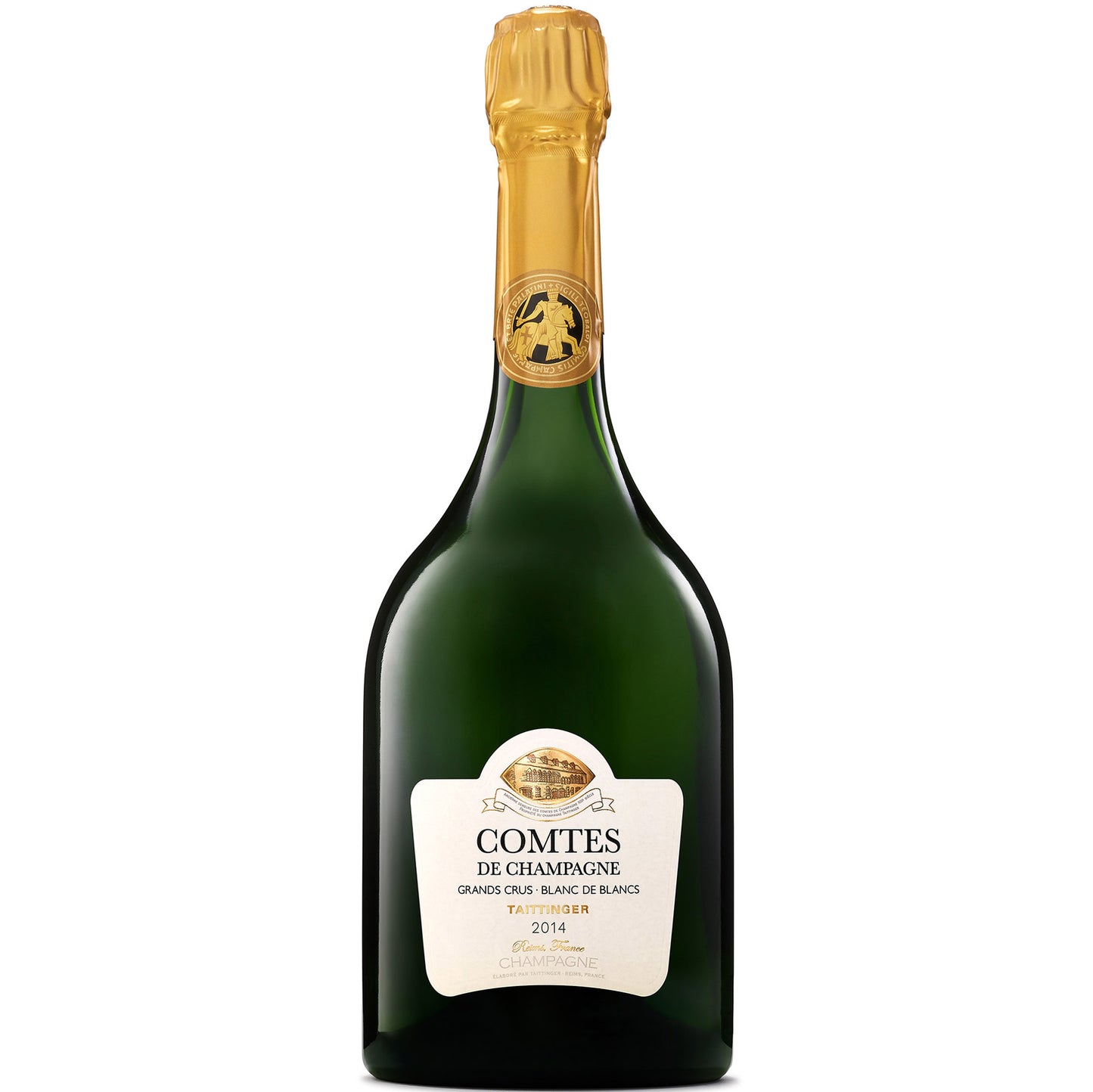
Taittinger, Comtes de Champagne Blanc de Blancs Brut, 2014 - Magnum
Taittinger, Comtes de Champagne Blanc de Blancs Brut, 2014 - Magnum
- 150cl
- 12.5%
- White Sparkling
- Chardonnay
Couldn't load pickup availability

Optimal drinking window: Now - 2045
The 2014 Comtes de Champagne is Chardonnay at its best. Only the finest fruit made it in, so quantities are way down compared to 2013, but the quality is superb. It’s the last of a run of cooler vintages in Champagne and already being hailed as a must-have for Champagne lovers.
Taittinger itself has a long backstory. Founded in 1734, it was taken on by Pierre Taittinger in 1931 after his WWI service in the region, and unusually for a big name, it’s still family-run today by Pierre’s great-grandchildren, Vitalie and Clovis. The cellars in Reims sit on 4th-century chalk caves that once belonged to Benedictine monks, and the deep cool conditions are spot-on for ageing Champagne slowly and gracefully.
Comtes de Champagne is the jewel in the crown: crafted only in the best years, from the first pressings, and aged for a full decade deep underground before release. Presented in elegant antique-style bottles, it’s one of the most iconic Blanc de Blancs in Champagne.
Right now, in 2026, the 2014 Comtes in magnum is in a beautifully poised adolescence — the primary citrus and floral energy is still vivid, but the decade on lees has already begun weaving in that toasty, nutty complexity that marks a great Blanc de Blancs in its stride. Between 2028 and 2035 we expect the wine to enter a particularly compelling phase as the chalk minerality integrates with richer honeyed and beeswax notes. The magnum format is the decisive factor here: the larger volume evolves more slowly and more gracefully than a standard bottle, meaning you can expect the wine to plateau somewhere around 2035-2040 rather than earlier. Decanter's 30-40 year window is ambitious but not unreasonable for a wine of this structure — the chalk-driven acidity is the engine that keeps it alive.
What the critics say:
"The 2014 Comtes de Champagne is pristine. In this tasting, it comes across as a mini-2008, similar in its linear personality, with just a touch more mid-palate creaminess. Readers will find a Comtes that plays in the realm of tension and energy. Citrus confit, white flowers, chalk, mint and chamomile are all finely sketched. Light tropical overtones grace the finish. What an absolute delight. The 2014 can be enjoyed now or cellared. Dosage is 9 grams per liter."
"Closed in style and character like the 2013, Taittinger's 2014 Brut Blanc de Blancs Comtes de Champagne reveals aromas of ripe orchard fruit, confit citrus, dried flowers, herbs, spring blossoms and mirabelle mingled with customary autolytic notes. Full-bodied, seamless and enrobing, it has a delicate, elegant, fleshy core of fruit and racy acids, all enhanced by a saline, fresh and penetrating finish marked by finesse and elegance. This refined, chalky-inflected Comtes de Champagne has the potential to age gracefully over the next 30-40 years."
"Apricots, hazelnuts, lemons, white flowers, sliced almonds and hints of licorice on the nose. It's creamy and layered, with soft, rounded bubbles that spread across the palate. Lovely balance of breadth, ripeness and freshness, with delicious wildflower honey and nut notes lingering. 100% grand cru chardonnay from Avize, Mesnil-sur-Oger, Oger, Cramant and Chouilly. Drink or hold."
Tasting Notes
AppearancePale gold with a greenish tint and a fine, persistent bead that rises in elegant streams.
NoseConfit lemon and white grapefruit give way to chamomile, dried white flowers, and a whisper of toasted hazelnut from the decade of lees ageing. There is a cool, almost flinty chalk quality underneath that keeps everything taut and focused.
PalateLinear and precise, yet with genuine creaminess at the centre — this is a wine of tension rather than weight. The acidity is racy without being austere, and there is a lovely apricot and wildflower honey quality on the mid-palate that stops it feeling severe. The mousse is fine and integrating beautifully in the magnum format.
FinishLong, saline, and mineral, with a last flicker of mint and citrus zest that simply will not let go.
Overall impressionA wine that earns comparison to the great 2008 but carries its own generosity — right now it rewards patience, but it is already showing enough to justify opening one and sitting on the rest.
Food Pairings
In the great brasseries of Reims and Épernay, a Blanc de Blancs of this calibre would arrive alongside a plateau de fruits de mer — oysters, langoustines, and sea urchin being the natural companions to that saline, chalky precision. Champagne's own cuisine is more robust than people expect: a classic local pairing would be a poularde à la crème, the rich cream sauce offset by the wine's acidity in the most satisfying way. Grilled Dover sole or a simple turbot with beurre blanc would be equally at home. For something more indulgent, aged Chaource or a slice of Époisses at the ripe end of its life makes the wine sing in a completely different register.
We think this wine would go well with
Serve at 10-12°C — cold enough to preserve the freshness, warm enough to let the aromatic complexity open up. In a magnum there is no need to rush: pour it into a large white Burgundy-style glass rather than a flute, which will give the wine space to breathe and let you actually smell what is going on. No decanting needed, though resting the magnum upright for 24 hours before opening is sensible. Pour slowly and let the first glass settle before diving in — it opens considerably over the first 20 minutes.
Comtes de Champagne draws exclusively from grand cru Chardonnay villages on the Côte des Blancs: Avize, Le Mesnil-sur-Oger, Oger, Cramant, and Chouilly. The soils here are almost pure chalk, which drains freely, forces the vine roots deep, and lends the wines that characteristic mineral salinity that no other sub-region in Champagne quite replicates. The cool continental climate preserves acidity naturally, which is everything in a wine built to age for decades. Taittinger's cellars in Reims, cut into 4th-century chalk caves beneath the city, maintain the steady cool temperatures that allow the wine to evolve at a pace most producers can only dream about.
Champagne is the northernmost sparkling wine appellation in France, governed by some of the strictest production rules in the wine world. Blanc de Blancs is a style made exclusively from white grapes — in practice, almost always Chardonnay — and it represents the purest, most precise expression the region offers. Within that, the Côte des Blancs is widely regarded as the spiritual home of grand cru Chardonnay, producing wines of far greater tension and longevity than those from the Montagne de Reims or Vallée de la Marne. Prestige cuvées like Comtes de Champagne must be made only from first pressings, which means more delicate juice, finer mousse, and considerably more complexity in the glass.
The 2014 vintage in Champagne fell into that category we rather like: unfashionable at the time, brilliant in hindsight. After a mild winter and early spring, summer delivered decent sunshine without the punishing heat that can strip acidity from the fruit. The harvest arrived in good order, though yields were generous enough to keep the accountants happy while quality remained sound across the region.
What emerged were Champagnes with proper backbone and freshness, the sort that make you remember why acidity matters so much in sparkling wine. The Chardonnay performed particularly well, bringing that mineral precision we love, while Pinot Noir added structure without heaviness. These bottles are drinking superbly now, showing the kind of balance that develops beautifully in the cellar, and should continue rewarding patience until 2030. Not a vintage that grabbed headlines, but one that quietly delivers exactly what great Champagne should.
FAQs
What does Comtes de Champagne taste like?
Think confit lemon, chamomile, toasted hazelnut, and wildflower honey, all held together by a racy, chalk-driven acidity and a long saline finish. It is precise and linear rather than rich and broad — this is a wine defined by tension and energy, with just enough creaminess from its decade on lees to stop it feeling austere.
When should I drink this?
It is drinking well now and will continue to do so for many years. In magnum format, we think the sweet spot is probably 2028 to 2040, when the chalk minerality and honeyed complexity will be at their most fully integrated. That said, if you open one tonight you will not be disappointed — just give it 20 minutes in the glass first.
Is the magnum format worth it?
For a wine like this, absolutely. Champagne ages more slowly and more evenly in magnum, which means the 2014 Comtes will reach its peak later and hold it longer than the same wine in a standard bottle. If you are buying to cellar, the magnum is the smarter choice by some margin.
What food should I serve with this?
Oysters and langoustines are the classic match — the saline, mineral quality in the wine mirrors the sea. Beyond that, grilled sole or turbot with a beurre blanc, a poularde à la crème, or even a well-aged Chaource all work superbly. It is versatile enough to carry a whole meal.
How is this different from regular Taittinger Champagne?
Comtes de Champagne is only made in the best years, from the first and finest pressings of 100% grand cru Chardonnay from five villages on the Côte des Blancs. It then spends a full decade ageing in Taittinger's chalk cellars before release. The non-vintage Brut Réserve is blended across years for consistency; Comtes is the opposite — a single-vintage statement of what the finest Chardonnay in Champagne can do when you give it time.
How should I serve this?
At 10-12°C, in a large tulip or white Burgundy-style glass rather than a flute. The extra surface area lets the aromas open up properly. No decanting needed, but rest the magnum upright for a day before opening and pour slowly. It improves noticeably in the glass over the first 20 minutes.

Explore related wines


What are you looking for tonight? Tell me the occasion, a grape, a region — or just try a suggestion below.
Your recommendations will appear here.
-
-
Speak to one of our Wine Gurus
Speak to a Wine GuruWith years of experience, our team can help you with all your wine buying and selling needs