

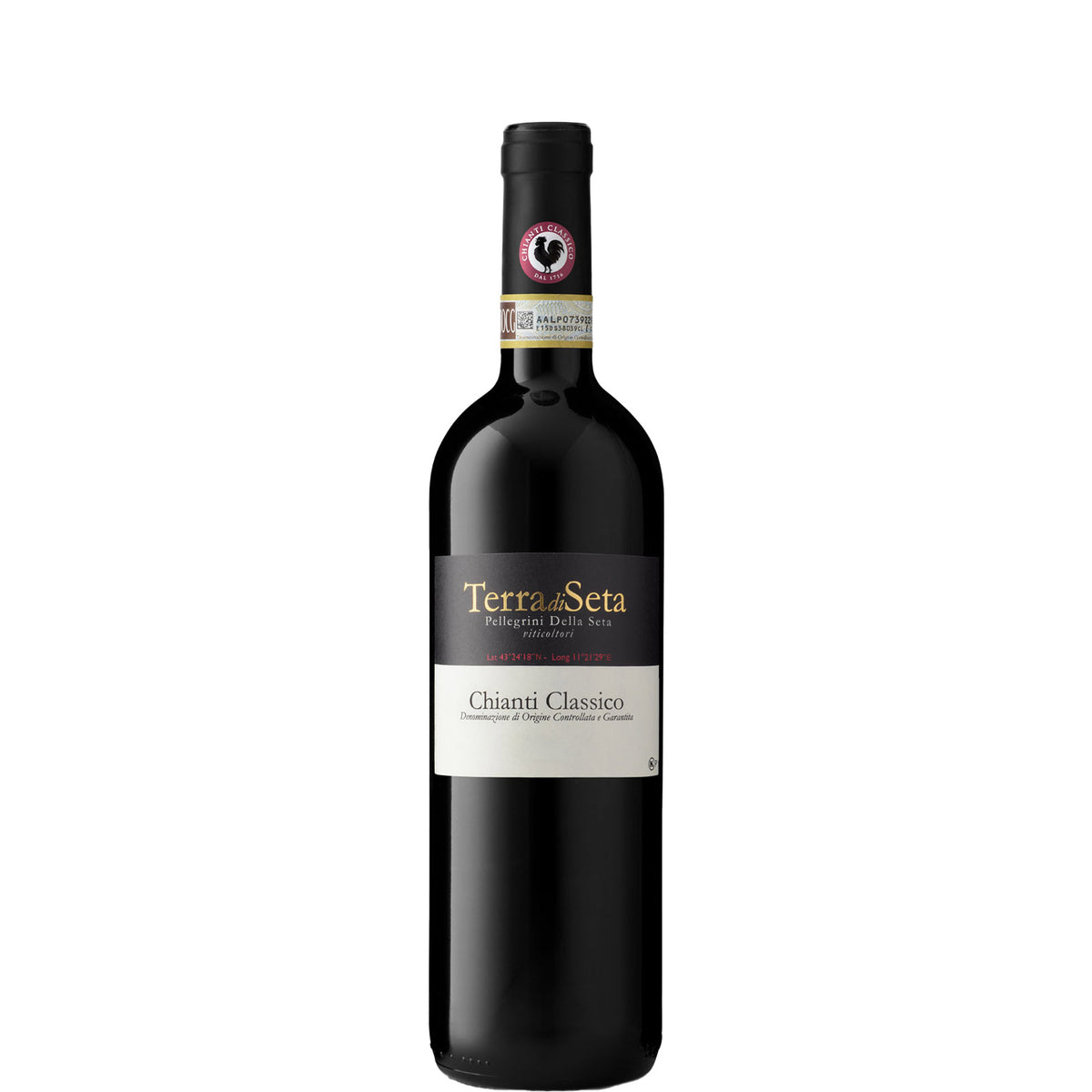
Terra di Seta, Chianti Classico, 2010
Terra di Seta, Chianti Classico, 2010
- 75cl
- 13.5%
- Red Still
- Sangiovese
- Organic
- Biodynamic
- Kosher
Couldn't load pickup availability

Optimal drinking window: 2026 - 2032
Terra di Seta is a small, family-run estate sitting in the heart of Chianti Classico, between Castelnuovo Berardenga and Siena. Their standard-bearer Chianti Classico is pure Sangiovese from organically farmed vineyards at around 400 metres, and the 2010 is a vintage that the zone's better producers wore like a badge of honour — cool, long, and precise, with the structure to age gracefully.
Expect dried cherry, iron, leather, and a whisper of tobacco and dried sage. The tannins are fine and resolved now, the acidity still fresh and lifting. This is Sangiovese at its most honest: no oak swagger, no international ambition, just the quiet confidence of a wine that knows exactly what it is.
The 2010 has already done its best ageing work. The primary fruit softened years ago and has given way to the dried cherry, leather, and earthy complexity that makes mature Sangiovese so rewarding. It is drinking well now, in that settled, confident phase before a wine starts to thin.
Tasting Notes
AppearanceMedium garnet with a brick-tinged rim, clear and bright for its age.
NoseDried cherry and pomegranate lead, with leather, tobacco leaf, and dried sage developing behind them. There is a characteristic iron-and-earth quality that is very much Sangiovese in maturity — earthy without being dusty, precise without being cool.
PalateMedium-bodied and poised, with fine-grained tannins that have fully resolved over sixteen years. The acidity is still doing its job — bright and food-hungry — and there is a satisfying core of dried red fruit and a faint anise note on the mid-palate. Nothing heavy, nothing blowsy.
FinishLong and savoury, with mineral persistence and a faint bitter-cherry note that is classically Tuscan.
Overall impressionA mature, honest Chianti Classico that has arrived at exactly the right place — drink it now while it still has life.
Food Pairings
In Siena, a wine like this would arrive alongside bistecca di chianina, cooked over wood coals with nothing but salt and a thread of olive oil. It is equally at home with wild boar ragu on pappardelle, the kind of slow-cooked sauce that fills a farmhouse kitchen on a Sunday. Pecorino di Pienza — aged, slightly sharp, crumbling at the edge — is a natural partner, as are the region's chicken liver crostini, rich and slightly bitter, which mirror the wine's own savoury character perfectly.
We think this wine would go well with
Serve at around 16 to 17 degrees Celsius — cool enough to keep the acidity lively, warm enough to let the dried fruit and leather open up. A brief decant of 20 to 30 minutes is worth doing, less to soften the wine than to give it a moment to breathe and show its full aromatic range. A medium-to-large Burgundy-style glass works well here, giving the nose room to open without dissipating it.
The vineyards sit at around 380 to 420 metres above sea level in the Castelnuovo Berardenga subzone, the southernmost and warmest part of Chianti Classico, where the soils shift towards galestro — the crumbly, schist-like limestone that drains freely and keeps vine stress in check. That altitude tempers what would otherwise be a generously warm growing season, preserving the acidity and freshness that Sangiovese needs to stay lively. The combination gives wines with more flesh than those from the cooler northern reaches of the Classico zone, but with enough mineral spine to age well.
Chianti Classico is the historic heart of the Chianti zone, occupying the hills between Florence and Siena and governed by its own DOCG separate from the broader Chianti appellation since 1996. Sangiovese must make up at least 80% of any Chianti Classico blend, though many producers — including Terra di Seta — go 100%. The zone introduced a three-tier classification in 2014: Chianti Classico, Chianti Classico Riserva, and Gran Selezione, with progressively stricter ageing requirements. The standard Chianti Classico, like this one, is built for earlier drinking than its bigger siblings but the best examples, especially from strong vintages, age with real elegance.
The 2010 growing season across Tuscany was cool and drawn out by the region's recent standards — a late, wet spring pushed back flowering, while a long, dry summer with significant diurnal temperature swings in August and September gave grapes extra time to build both phenolic ripeness and natural acidity. The harvest came in late but in excellent condition. What that combination produced was something genuinely exciting: wines with the structure and concentration of a great year, but without the blowsiness that can creep into hotter vintages. Sangiovese in particular responded brilliantly — the variety loves that push-pull between warmth and cool nights, and 2010 gave it in spades.
The result is a vintage that serious Tuscan collectors rightly hold in high regard, particularly for Brunello di Montalcino and Chianti Classico Riserva. These are wines built for the long haul: firm, fine-grained tannins, real backbone, and the kind of acidity that keeps everything fresh a decade and more on. The best bottles are only now hitting their stride, and the finest Brunellos have plenty of road left. If you're drinking them now, give them air and time in the glass. If you're sitting on them, sit a little longer — until 2030 and beyond for the top names.
FAQs
What does this wine taste like?
Dried cherry, leather, iron, and dried herbs with fine-grained tannins and a long savoury finish. It has the classic bitter-cherry character of mature Sangiovese, earthy and mineral rather than fruit-forward.
Is this wine ready to drink now?
Yes, and it is in a very good place right now. The tannins have fully resolved, the acidity is still fresh, and the secondary complexity of leather and earth has developed nicely. No need to wait — but it will hold until around 2032.
What food should I serve with this?
Sangiovese and red meat are a pairing Tuscany has spent centuries perfecting. A slow-roasted lamb would work beautifully. Aged pecorino is a simpler option that works just as well at the table or before dinner.
How should I serve it?
Around 16 to 17 degrees Celsius, with a short decant of 20 to 30 minutes. A medium-to-large bowl glass gives the nose the space it needs. Avoid serving it too warm — it will go flat.
Is Terra di Seta organic or biodynamic?
Yes — the estate holds Demeter biodynamic certification and farms organically across its vineyards. It is one of a small group of Chianti Classico producers farming with genuine ecological seriousness.
How does the 2010 vintage compare to others in Chianti Classico?
2010 is widely regarded as one of the stronger recent vintages in Chianti Classico — a cool, long growing season that gave wines with fine structure and real freshness. Compared to the riper 2011 or the sometimes uneven 2009, 2010 produced wines with more precision and better ageing potential.

OUR GROWERS
Terra di Seta
Explore related wines


What are you looking for tonight? Tell me the occasion, a grape, a region — or just try a suggestion below.
Your recommendations will appear here.
-
-
Speak to one of our Wine Gurus
Speak to a Wine GuruWith years of experience, our team can help you with all your wine buying and selling needs