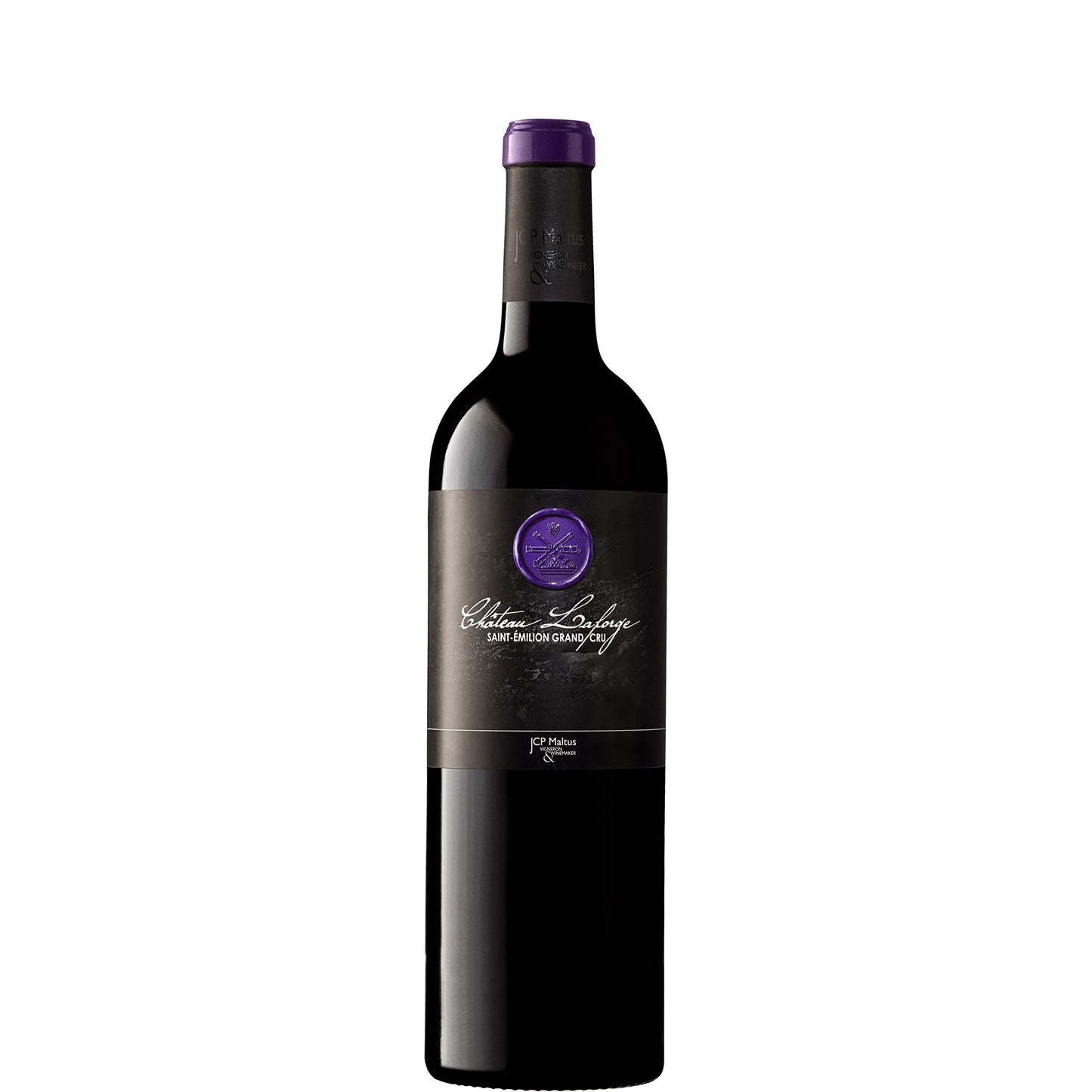

Château Laforge, 2025
Château Laforge, 2025
- 75cl
- 14%
- Red Still
- Merlot, Cabernet Franc
Please note, en primeur wines are not available for delivery until they arrive in the UK
Couldn't load pickup availability
Enquire about this item
Est. delivery in 2028
JCP Maltus, the Englishman behind Teyssier and Le Dôme, crafts this Saint-Émilion from carefully selected parcels on the limestone plateau. We love how he balances power with elegance, creating wines that speak clearly of their Right Bank origins while carrying his signature precision.
What the critics say:
"Deep dark ruby garnet, opaque core, violet reflections, subtle edge brightening. Delicate floral nuances, black cherries, a hint of blackberry confit, a hint of black truffle, precious wood nuances. Complex, ripe dark berry fruit, ripe tannins, mineral, fine sweetness on the finish, an elegant food companion, good ageing potential."
The vineyards benefit from Saint-Émilion's prized limestone plateau and côtes, with clay-limestone soils that retain moisture while providing excellent drainage. The elevated position captures morning sun whilst avoiding excessive afternoon heat, creating ideal conditions for Merlot and Cabernet Franc. These ancient limestone foundations impart the mineral backbone that defines great Saint-Émilion, whilst the clay component ensures richness and depth of fruit.
Saint-Émilion is Bordeaux's most beautiful appellation, where limestone meets legend on the Right Bank. Unlike the Médoc's gravel-driven Cabernet Sauvignon, here Merlot reigns supreme, supported by Cabernet Franc that thrives in the cooler clay-limestone soils. The appellation's classification system, regularly revised unlike the static 1855 system, keeps producers on their toes. Saint-Émilion's wines tend toward elegance rather than power, with a silky texture that makes them more approachable young than their Left Bank cousins.
The 2025 Bordeaux vintage emerged from one of the most demanding growing seasons in recent memory — the earliest budbreak since 1989, June temperatures second only to 2003 since records began, and an unusually early harvest beginning in August for the whites. Conditions that should have produced heavy, overripe wines. They didn't. Decanter's Georgie Hindle, who tasted close to 200 wines ahead of the formal campaign, describes "exceptional concentration, aromatic purity and a freshness that contradicts the record-breaking heat.
The early critical consensus places 2025 stylistically between the precision of 2020 and the structure of 2016, with the brightness of 2023 — a combination that suggests a very serious vintage indeed. Yields are dramatically low, the smallest crop since 1991, with production across the Gironde running around 15% below the five-year average. The quality is here. There simply isn't very much of it.