

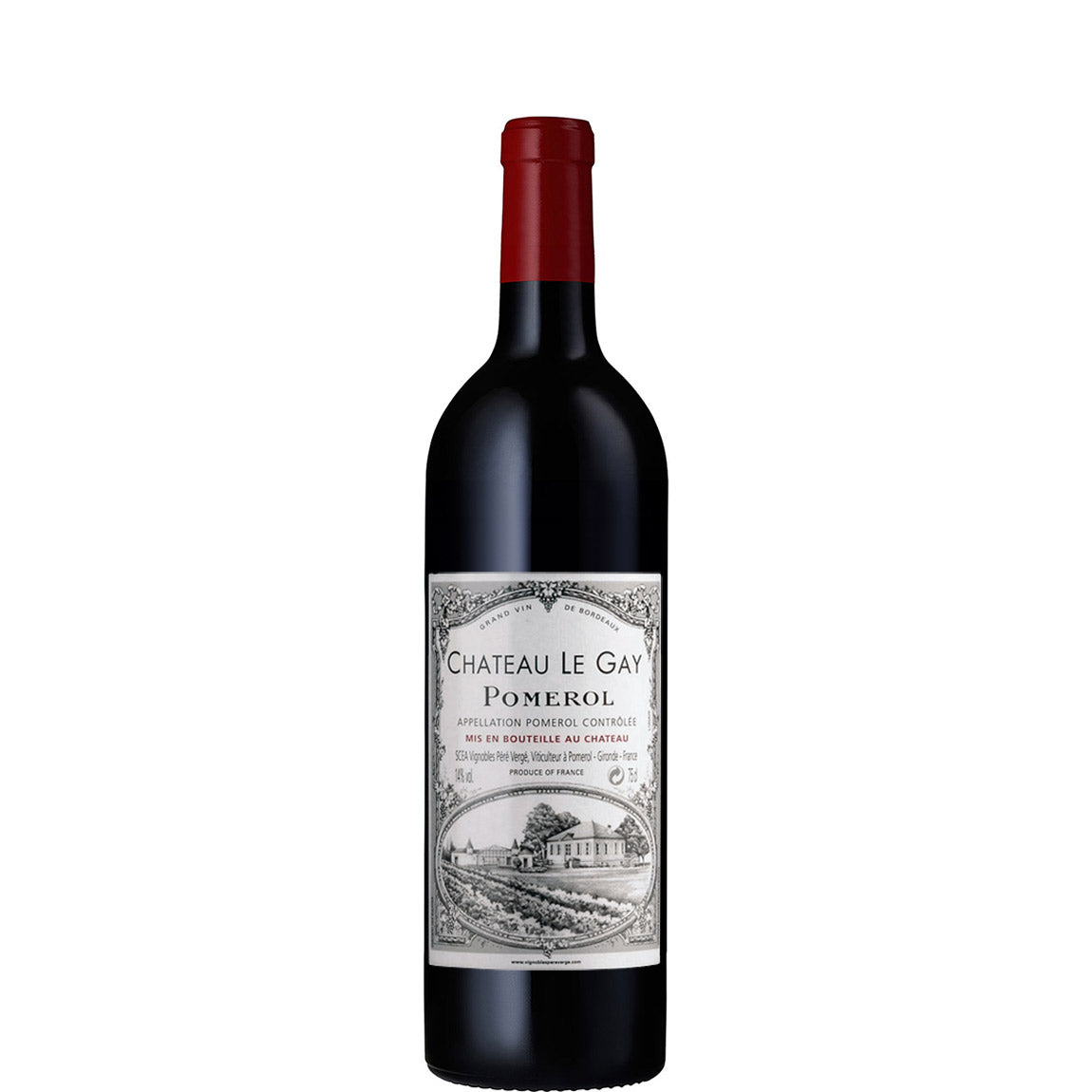
Château Le Gay, 2000
Château Le Gay, 2000
- 75cl
- 13.5%
- Red Still
- Merlot, Cabernet Franc
Couldn't load pickup availability

Optimal drinking window: 2026 - 2038
This is a mature, refined Pomerol from one of the classic estates of the Right Bank.
Château Le Gay is a single-estate property of about 10.5 hectares, located on the Pomerol plateau. Its soils are a mix of clay and gravel, typical of the region. The estate was acquired by Catherine Péré-Vergé in the early 2000s and her son, Henri Parent, now oversees the estate. The cellar was modernised (including micro-vinification) to improve precision and parcel-by-parcel expression.
At 26 years old, Le Gay 2000 is now entering its proper drinking window after a long, slow evolution. The primary dark fruit has softened and begun to integrate with earthy, secondary complexity — black tea, iron, dried herbs — that is the hallmark of mature Right Bank Merlot from a structured vintage. It's unlikely to gain significant new dimensions from here, but it should hold comfortably until around 2032 to 2035 before the fruit begins to recede more noticeably. Beyond 2038, the wine may start to feel attenuated — still interesting for those who enjoy the forensic pleasure of older Bordeaux, but past its peak. If you have bottles, now is the time to start opening them.
What the critics say:
"A powerful, firm, chunky offering with a dense plum/purple color, notes of Chinese black tea intermixed with vitamins, minerals, earth, black currants, and cassis, this 2000 is a relatively rugged, tannic, old-style wine that should develop well in spite of moderately high tannin and a hint of rusticity. As I said last year, those with 19th century tastes will go ga-ga over Le Gay's 2000. P.S. Le Gay was sold in 2002 to Catherine Pere-Verge, who has hired Michel Rolland. Rolland believes that Le Gay can become one of the great Pomerols of the appellation given its terroir and history of extraordinary wines in the late forties."
Tasting Notes
AppearanceDeep garnet, still quite dense at the core with a gently fading brick rim that speaks to honest age.
NoseDark plum and cassis are the foundation, but what gives this wine its character is the earthy, iron-rich mineral note underneath — almost like wet clay and graphite. Black tea and a faint dried herb quality add complexity that only comes with time in bottle.
PalateFull-bodied and still quite structured, with firm tannins that have softened but haven't quite fully integrated — there's a slight grip that keeps everything taut. Dark fruit, mineral earth, and a savoury, almost meaty mid-palate give it real presence. Not a wine that flatters immediately, but the substance is undeniable.
FinishLong, dry, and mineral, with black tea and iron-tinged earth lingering well after the fruit has faded.
Overall impressionA serious, old-school Pomerol that rewards patience and demands food — it's at its best now with another decade still ahead of it.
Food Pairings
In the Périgord and Bordelais, a wine like this would traditionally sit alongside a slow-braised beef daube, cooked with wine, lardons, and root vegetables until the whole thing collapses into something deeply savoury. Duck confit — skin crisped, fat rendered — is another natural partner, as is a thick-cut côte de boeuf from the wood-fired grill. The earthier, more tannic edge of Le Gay also makes it genuinely good with dishes involving mushrooms, particularly cèpes cooked simply in butter and garlic. A wedge of aged Comté or Cantal at the end of a meal would be no bad thing either.
We think this wine would go well with
Serve at around 17°C — any warmer and the alcohol begins to dominate what is already a full-bodied wine. Decanting is essential: give it a good 90 minutes to two hours to open fully, as the tannins need air to show their best face. A large Bordeaux balloon will give the wine room to breathe in the glass and let the more subtle mineral and tea-like notes emerge. Don't rush it — this is a wine that reveals itself slowly.
Le Gay sits on the Pomerol plateau, arguably the most coveted few square kilometres in all of Bordeaux. The soils are a mix of clay and gravel — clay retains water and keeps Merlot cool and slow-ripening in warm years, while gravel brings drainage and warmth to the root zone. That combination tends to produce wines with density and iron-rich mineral grip, and Le Gay's 2000 shows both in spades. The plateau's elevation is modest but meaningful in a region where a few metres can shift drainage dramatically.
Pomerol sits just to the northeast of Saint-Émilion on Bordeaux's Right Bank and, uniquely among serious Bordeaux appellations, has no official classification system. What it does have is Pétrus, Le Pin, and a clutch of small estates on iron-rich clay soils that produce some of the world's most sought-after Merlot-dominant wines. Compared to the Médoc's gravelly left bank, Pomerol tends toward more plush, fleshy wines — though the older-school estates like Le Gay push that richness through a denser, more structured lens. Yields are typically low, estates tiny, and the wines correspondingly rare.
The 2000 vintage in Bordeaux arrived with a sense of millennial occasion, and for once, the hype had something behind it. The growing season was largely favourable, with a warm, dry summer that allowed grapes to ripen steadily without the drama of late-season rain washing out the finish line. September delivered the kind of weather winemakers dream about: fine, warm days that concentrated the fruit while preserving freshness. Cabernet Sauvignon on the Left Bank performed particularly well, producing wines with firm but ripe tannins and real depth of fruit. Merlot on the Right Bank was similarly impressive, giving Pomerol and Saint-Émilion some of their most complete wines in years.
The result is a vintage that sits confidently in the top tier without being flashy about it. These are serious, structured wines — serious in the sense that they were built to last and have largely done so with great composure. The best Left Bank estates are hitting their stride now, offering the kind of balance between fruit and secondary development that makes older Bordeaux worth the wait. Drink the better Médocs until 2030 and beyond; the Right Bank wines are arguably at or just past their peak, so if you have bottles, now is the time to open them rather than admire them.
FAQs
What does Château Le Gay 2000 taste like?
This is old-style Pomerol — dense, serious, and built on dark plum, cassis, black tea, and iron-rich earth rather than easy fruit. The tannins are firm and the mineral backbone is pronounced. It's a wine that makes you lean in rather than lounging back.
When should I drink this wine?
It's drinking well now and will continue to do so until around 2035, possibly 2038 for those who enjoy their Bordeaux in a more austere, evolved state. Don't wait much longer than that — the fruit will start to thin before the tannins fully resolve.
Does this wine need decanting?
Yes, and generously. Allow at least 90 minutes to two hours in a large decanter before serving. The wine has structure that needs air to open up, and the more subtle secondary notes — black tea, mineral earth — only emerge once it's had time to breathe properly.
What food works best with this wine?
Think slow-cooked, rich, savoury dishes: braised beef, duck confit, côte de boeuf, or anything involving cèpe mushrooms. The wine's tannic grip and earthy character needs food with real body and flavour to match it.
Is this wine worth cellaring further?
It has already done most of its ageing work, so holding it longer is a matter of personal taste rather than necessity. If you enjoy the secondary complexity of fully mature Bordeaux — more earth, leather, and dried herbs than fresh fruit — then a few more years won't hurt. But the window is open now, and there's no real upside to leaving it much beyond 2035.
How does the 2000 vintage compare to Le Gay's later releases?
The 2000 was the final vintage under the old ownership and reflects the estate's pre-modernisation character — more rustic, tannic, and old-school than what came after Catherine Péré-Vergé and Michel Rolland took over in 2002. Later vintages are more polished and parcel-precise. This one is a different animal entirely: less immediately charming, more demanding, and arguably more historically interesting for it.


What are you looking for tonight? Tell me the occasion, a grape, a region — or just try a suggestion below.
Your recommendations will appear here.
-
-
Speak to one of our Wine Gurus
Speak to a Wine GuruWith years of experience, our team can help you with all your wine buying and selling needs