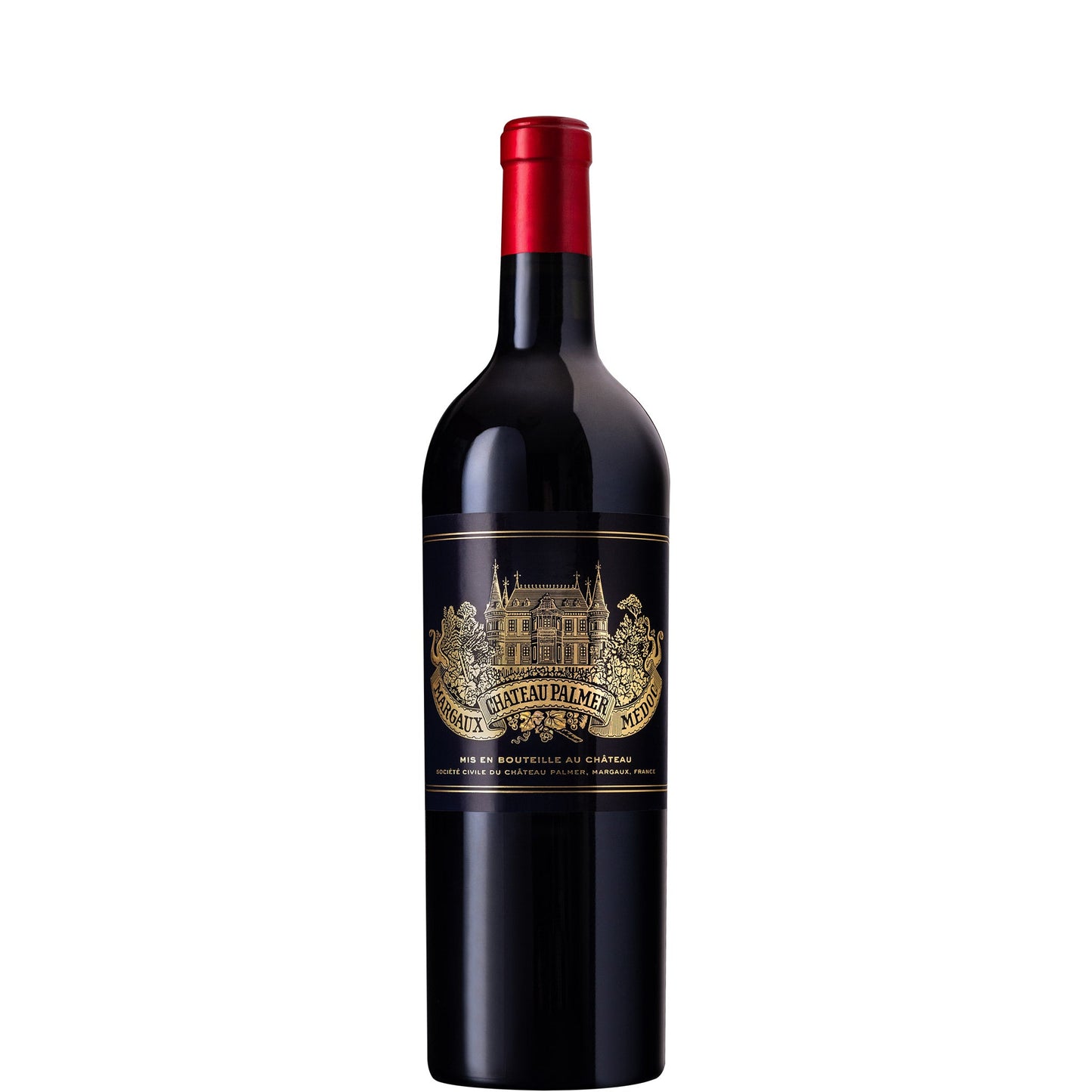

Château Palmer, 2025
Château Palmer, 2025
- 75cl
- 13.5%
- Red Still
- Cabernet Sauvignon, Merlot, Petit Verdot
- Organic
- Biodynamic
Please note, en primeur wines are not available for delivery until they arrive in the UK
Couldn't load pickup availability
Enquire about this item
Est. delivery in 2028
Château Palmer sits in that rarefied air where Left Bank structure meets Right Bank sensuality, and this 2025 magnum captures exactly why we've long considered it Margaux's most beguiling estate. The blend favours Cabernet Sauvignon with a healthy dose of Merlot and a splash of Petit Verdot, creating wines that dance between power and elegance.
What the critics say:
"Iris, violets, and roses might start the aromatics, but that's not all there is, as you also find cherries, currants, dried flowers, and hints of spice, which are all front and center. The palate, however, is the star of the show. The combination of vibrant, sweet, ripe, clean, and pure fruits, coupled with its vivid energy, drives the long, seamless, elegant, and sensuous finish. There is concentration and power, but everything is so refined that it is not something you notice. The finish starts off slowly, building into a crescendo of perfectly ripe fruits. The key to the vintage was the late-August rains, which allowed for lower ABV and better fruit maturity. The wine blends 55% Cabernet Sauvignon, with 41% Merlot, and 4% Petit Verdot. 13.5 % ABV, 3.7 pH. The yields were small at 20 hectoliters. The harvest took place from September 4 to September 25. This is the earliest start to a harvest in the history of the estate."
"One of the most refined and seamless wines of the vintage is the 2025 Palmer, a blend of 55% Merlot, 41% Cabernet Sauvignon and 4% Petit Verdot that wafts from the glass with aromas of sweet blackberries, plums and licorice complemented by floral accents of violet and wisteria (yes, the window of the tasting room was closed). Full-bodied, suave and layered, with a deep and concentrated core of fruit, bright acids and supple tannins, it's already harmonious and complete, concluding with a long, penetrating finish. At only 13.5% alcohol, this is quite a bit lower than most recent sunny vintages at Palmer."
"The 2025 Palmer is unusual in that Merlot drives the blend this year. That results in an unusually juicy Grand Vin. Even so, there's plenty of supporting structure. The blend is 55% Merlot, 41% Cabernet Sauvignon and 4% Petit Verdot. Black fruit, lavender, menthol, licorice, gravel and chocolate build into a driving, potent finish. There's a lot of gravitas and substance here. I am very much looking forward to tasting this as a finished wine; my impression today is that the 2025 is holding back quite a bit of its potential."
"A brilliant, dense purple-hued wine cut from the same cloth as its stablemate, the 2025 Château Palmer offers a massive array of red, blue, and black fruits supported by chalky minerality, liquid violets, and graphite on the nose. Based on 55% Merlot, 41% Cabernet Sauvignon, and 4% Petit Verdot that's being raised in 50% new barrels and foudres, it checks in at 13.5% alcohol with a pH of 3.7. It's full-bodied on the palate, with a round, sexy mouthfeel, beautiful tannins, and a great finish. It's much more structured and tannic compared to the Alter Ego, with a slightly more inward style, yet it has enough fruit and texture to offer pleasure early, and it's going to deserve at least a decade of cellaring."
The 55-hectare vineyard sits on Margaux's finest gravel soils, deep beds of Günzian gravel over limestone and clay that provide perfect drainage while retaining enough moisture for the vines. The proximity to the Gironde estuary moderates temperatures and extends the growing season, allowing for slow, even ripening. These warm, well-drained soils favour Cabernet Sauvignon while pockets of clay support Merlot, creating the ideal terroir for Palmer's signature blend of power and elegance.
Margaux produces some of Bordeaux's most elegant and perfumed wines, where finesse matters more than raw power. The appellation's deep gravel soils and maritime climate create wines with distinctive floral aromatics and silky tannins. Unlike the more muscular wines of Pauillac or Saint-Estèphe, Margaux rewards subtlety and patience, developing complex secondary aromatics that can include violet, rose petal, and exotic spices. Palmer exemplifies this house style while adding its own signature intensity.
The 2025 Bordeaux vintage emerged from one of the most demanding growing seasons in recent memory — the earliest budbreak since 1989, June temperatures second only to 2003 since records began, and an unusually early harvest beginning in August for the whites. Conditions that should have produced heavy, overripe wines. They didn't. Decanter's Georgie Hindle, who tasted close to 200 wines ahead of the formal campaign, describes "exceptional concentration, aromatic purity and a freshness that contradicts the record-breaking heat.
The early critical consensus places 2025 stylistically between the precision of 2020 and the structure of 2016, with the brightness of 2023 — a combination that suggests a very serious vintage indeed. Yields are dramatically low, the smallest crop since 1991, with production across the Gironde running around 15% below the five-year average. The quality is here. There simply isn't very much of it.