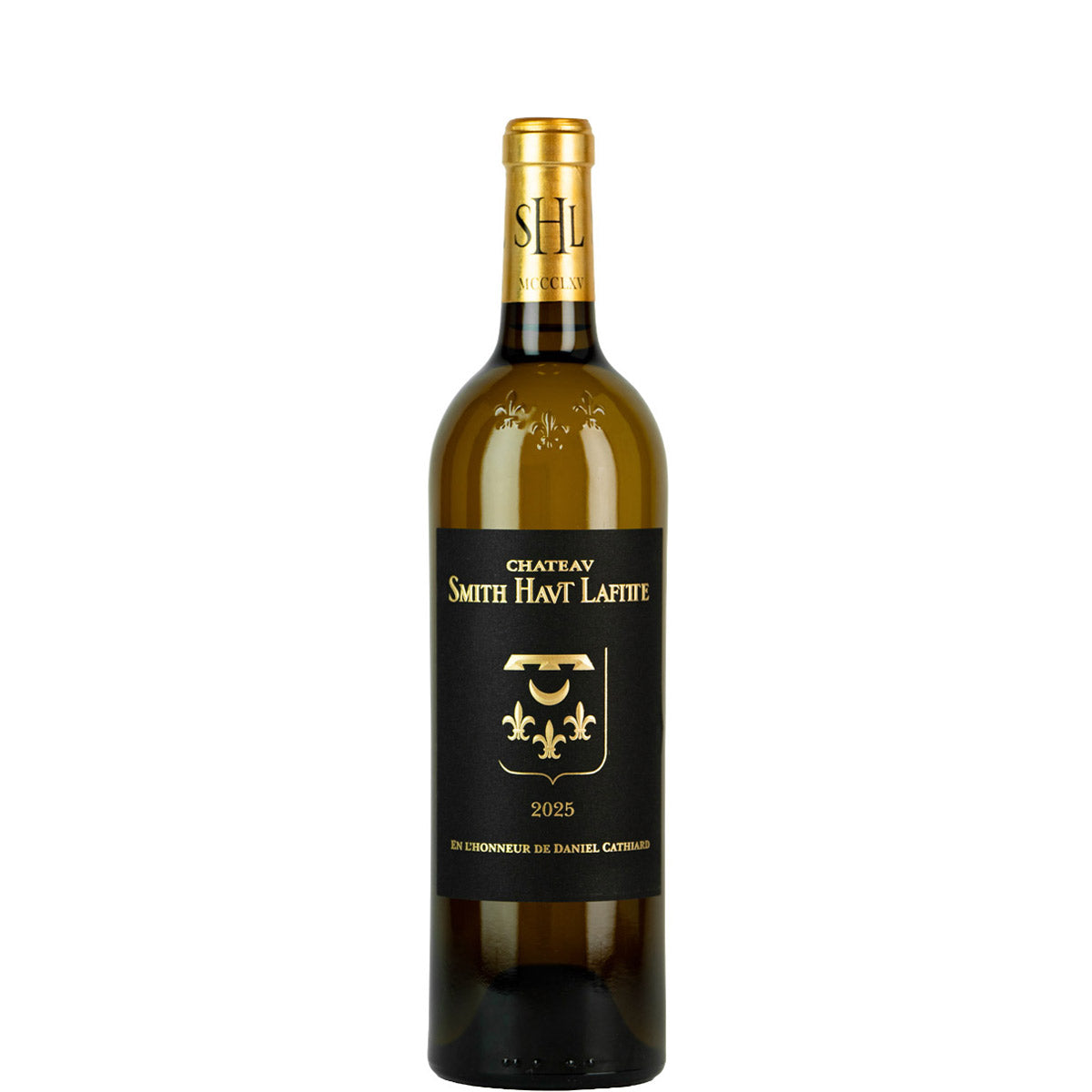

Château Smith Haut Lafitte Blanc, 2025
Château Smith Haut Lafitte Blanc, 2025
- 75cl
- 14%
- White Still
- Sauvignon Blanc, Sémillon, Sauvignon Gris
- Organic
- Biodynamic
Please note, en primeur wines are not available for delivery until they arrive in the UK
Couldn't load pickup availability
Enquire about this item
Est. delivery in 2028
Château Smith Haut Lafitte produces one of Pessac-Léognan's most serious white wines from their gravelly slopes in the heart of Bordeaux's Left Bank. This Sauvignon Blanc and Sémillon blend spends time in oak, creating a wine that marries Bordeaux's classical restraint with remarkable depth and complexity.
What the critics say:
"Light greenish yellow, silver reflections. Fresh herbs, a hint of pear and melon, yellow gooseberries, delicate wood spice, candied grapefruit zest, underlaid with white flowers, multi-faceted bouquet. Complex, powerful, mineral, white stone fruit, salty aftertaste, some blossom honey, has great length, sure maturity potential."
"Vanilla, caramel, warm honey, wax, dried herbs, flint, cool white peach and apple aromas. Explosive and alive, gorgeously clear and clean – there’s nuance and complexity here – but it’s lightly presented and delicate for Smith. Quite a streamlined style but actually the acidity is really well balance and not at all pronounced or too sharp. Clarity and cool freshness. Beautifully delineated, sophisticated with more tension and drive and energy than 2023. I like this a lot, a tiny dollop of sweet, tropical fruit with bitter elements too. The harvest for whites began on 20th August until 2nd September. A yield of 18hl/ha."
"Pale gold colour, clearly the most structured, and reserved of the three estate white wines, showcasing bright vivid citrus and mint leaf, liquorice, sea spray, oyster shell, wet stones, white tea, nectarine pit, quince as it widens in the glass. Flavourful, with long ageing potential, love this. 18hl/h yield from these 80 to 90 year old vines. Expect a special label to commemorate the last vintage of Daniel Cathiard."
"Bright aromas of sliced apples, pears and lemons, with some acacia and flint. Vibrant. The palate is dense and tight, with so much chalk and oyster shell character. Extremely long and pure, with vivid energy at the end. Sharp and driven by acidity. pH 3.2. A blend of 90% sauvignon blanc, 5% semillon and 5% sauvignon gris."
The white wine vineyards sit on the estate's highest slopes, planted on deep gravel beds over limestone and clay subsoils typical of Pessac-Léognan. This well-draining terroir provides excellent water regulation while the limestone contributes crucial mineral structure to the wines. The maritime influence from the nearby Gironde estuary moderates temperatures, extending the growing season and allowing for optimal phenolic ripeness. These gravelly soils warm quickly in spring and retain heat through the growing season, perfect for achieving full aromatic development in both Sauvignon Blanc and Sémillon.
Pessac-Léognan was carved out of the northern Graves in 1987 to recognise the superior quality of its ten classified growth châteaux, including Smith Haut Lafitte. The appellation's gravelly soils and slightly warmer microclimate produce more structured, age-worthy wines than the broader Graves region. White wines must be made from Sauvignon Blanc, Sémillon, and Muscadelle, with the best producers like Smith Haut Lafitte creating blends that combine Sauvignon's aromatics with Sémillon's texture and longevity. Unlike Sauternes to the south, Pessac-Léognan focuses on dry whites that rival the finest from Burgundy for complexity and cellaring potential.
The 2025 Bordeaux vintage emerged from one of the most demanding growing seasons in recent memory — the earliest budbreak since 1989, June temperatures second only to 2003 since records began, and an unusually early harvest beginning in August for the whites. Conditions that should have produced heavy, overripe wines. They didn't. Decanter's Georgie Hindle, who tasted close to 200 wines ahead of the formal campaign, describes "exceptional concentration, aromatic purity and a freshness that contradicts the record-breaking heat.
The early critical consensus places 2025 stylistically between the precision of 2020 and the structure of 2016, with the brightness of 2023 — a combination that suggests a very serious vintage indeed. Yields are dramatically low, the smallest crop since 1991, with production across the Gironde running around 15% below the five-year average. The quality is here. There simply isn't very much of it.