

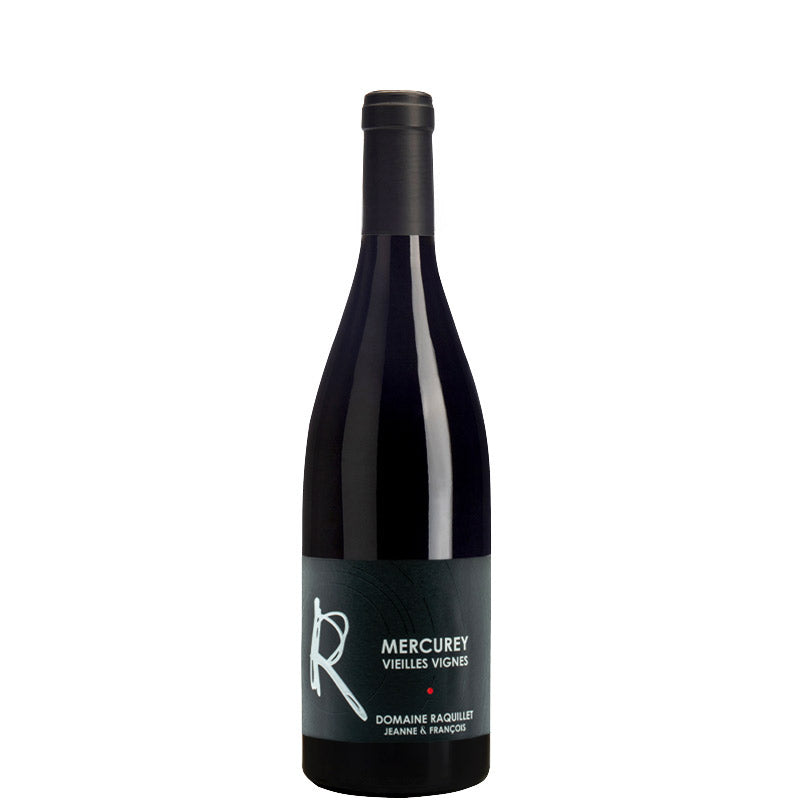
Mercurey Rouge Vieilles Vignes, Domaine François Raquillet, 2024
Mercurey Rouge Vieilles Vignes, Domaine François Raquillet, 2024
- 75cl
- 13%
- Red Still
- Pinot Noir
Couldn't load pickup availability

Optimal drinking window: 2026 - 2034
Mercurey is the Côte Chalonnaise's quiet overachiever — serious Pinot Noir at a fraction of the price of its Côte de Nuits neighbours, and Raquillet is one of the appellation's most dependable names.
This Vieilles Vignes bottling comes from the domaine's oldest vines, which pull more concentration and detail from the limestone-clay soils than younger plantings ever could. The result is a red Burgundy with real presence: bright red fruit, a stony, iron-edged mineral quality, and tannins that have genuine grip without any roughness.
"An imperial, dark purple hue. The nose lifts exuberantly from the glass with poached plum, cassis and redcurrant, threaded with violet, clove and star anise. Deep, resonant and a touch brooding in its youth, the palate reveals a concentrated core of dark fruit wrapped in firm, powdery tannins. A serious, structured and confidently age-worthy Mercurey from Domaine Raquillet."
Tom Harrow, Head Wine Guru
Critics consistently champion the domaine: Neal Martin calls the Vieilles Vignes “utterly delicious,” William Kelley praises its depth and precision, and Burghound regularly scores the wines at levels normally seen in top Premier Crus.
“The Côte Chalonnaise experienced a very different growing season than the rest of Burgundy, and it is very much a year to pay attention to these wines. Almost across the board they are highly delicious.”
Christy Canterbury MW, Tim Atkin
Domaine Raquillet is one of Tim Atkin's 2024 Top 10 Côte Chalonnaise Producers.
Right now, the 2024 is in a pleasingly open, fruit-forward phase — the red cherry and raspberry are vivid and the tannins are supple enough to drink with real enjoyment. Over the next two to three years, the wine will begin to integrate further, the fruit softening slightly as more earthy, mushroomy secondary character starts to emerge. The old-vine structure means there is genuine medium-term cellaring potential here, and we think the sweet spot is likely somewhere between 2028 and 2031.
What the critics say:
"€: Value wines that are especially worth seeking out"
Tasting Notes
AppearanceClear, medium ruby with a bright, youthful rim.
NoseFresh red cherry, raspberry, and a suggestion of dried rose petal lead the way. Underneath, there is a cool, stony, almost iron-like quality that anchors the fruit and signals the old-vine depth. A faint earthiness — the Burgundian kind, damp soil after rain — adds character without heaviness.
PalateThe 2024 vintage has given this wine a fruit-forward, relatively open personality, with red cherry and cranberry coming through cleanly on entry. Tannins are fine-grained and present but not imposing, and the acidity is the natural, mouth-watering kind that makes you want another sip. Old-vine concentration adds a mid-palate richness that distinguishes this from a straight village bottling.
FinishPersistent and mineral, with a clean, slightly saline quality that lingers long after the fruit has faded.
Overall impressionA textbook Mercurey with old-vine depth — honest, precise, and very easy to love at the table.
Food Pairings
In the Chalonnaise, this kind of wine is almost invariably poured alongside coq au vin or a poulet de Bresse roasted simply with butter and tarragon — the wine's acidity and red fruit cut through the richness perfectly. Locals also reach for it with époisse or comté, the region's great cheeses, where the mineral quality in the wine holds its own against powerful dairy. Boeuf bourguignon is the obvious classic pairing, and it remains obvious for good reason. Lighter preparations work too: a terrine of rabbit or a slice of jambon persillé from Dijon would be right at home.
We think this wine would go well with
Serve at around 15-16°C — cool enough to keep the freshness alive, but not so cold that the fruit closes down. This wine does not need decanting in any formal sense, but pouring it thirty minutes before you sit down will open it up noticeably. A standard Burgundy glass — wider bowl than a Bordeaux glass, narrower than a large Burgundy balloon — will concentrate the aromatic detail without dissipating it.
The old vines used for this cuvée are planted in Mercurey's characteristic mix of limestone and clay soils, sitting on the gentle slopes and plateaux of the Côte Chalonnaise. The limestone provides the mineral backbone and natural acidity that gives Mercurey its distinctive stony edge, while the clay fraction adds weight and texture. Altitude here is lower than the Côte de Nuits, and the climate slightly more continental, meaning the growing season is warm enough for reliable ripeness but cool enough to preserve the freshness that defines good Burgundy.
Mercurey is the largest and most important appellation in the Côte Chalonnaise, producing mostly red wine from Pinot Noir. It sits south of the Côte de Beaune and offers a similar character — red fruit, mineral precision, and food-friendly acidity — at significantly more accessible prices. The appellation has 32 classified premier cru vineyards, giving serious producers like Raquillet the framework to express genuine site differences. Compared to its neighbour Givry, Mercurey tends to produce slightly more structured, age-worthy reds with a more pronounced mineral quality.
The 2024 growing season in Burgundy was, frankly, a test of nerve. A wet spring brought significant mildew pressure, and vignerons who stayed sharp in the vineyard — working fast, keeping canopies open, reducing yields where necessary — came out the other side with something worth talking about. Summer brought warmer, drier conditions that helped the fruit recover composure, and harvest arrived broadly on the later side, with growers picking carefully to find phenolic ripeness without sacrificing freshness. Quantity was down across much of the Côte, which concentrates minds as much as it concentrates wine.
What emerged is a vintage that rewards those who put the work in. The Pinots we have tasted carry real precision and translucency — not because they are light, but because the acidity is lively and the fruit unforced. Chardonnays from the Côte de Beaune look particularly promising: taut, mineral, with genuine length. This is not a vintage to panic-open. Most village and premier cru reds want three to five years at minimum, with the better appellations drinking well until 2035 and beyond. The whites are more approachable now, though the best will reward patience too.
FAQs
What does this wine taste like?
Think fresh red cherry, raspberry, and a cool stony mineral quality — the hallmarks of Mercurey Pinot Noir. The old vines add a mid-palate richness that lifts this above a standard village red, and the tannins are fine and well-integrated. It is precise and food-friendly rather than showy.
When is the best time to drink this wine?
It is already approachable and drinking well from 2026, which is one of the pleasures of the 2024 vintage's fruit-forward character. That said, it will reward a few years of patience — we think it will be at its most complete between 2028 and 2031.
What food should I serve with this wine?
Classic Burgundian cooking is the obvious answer: coq au vin, roast chicken with herbs, or boeuf bourguignon. It also works very well with charcuterie, terrines, and aged cheeses like comté or gruyère. The wine's acidity and mineral edge make it versatile at the table — it is not a wine that needs a grand occasion to shine.
Is this worth cellaring?
Yes, within reason. The old-vine depth gives this more structure than a typical village Mercurey, and it will develop nicely over six to eight years.
How should I serve this wine?
Serve it at around 15-16°C — slightly cooler than room temperature in most British homes. No need for a lengthy decant, but give it thirty minutes in the glass or jug before sitting down to eat. A standard Burgundy glass is ideal: it focuses the aromatics without letting them escape too quickly.
How does Raquillet compare to other Mercurey producers?
Raquillet is one of the most consistent and respected names in the appellation — not the most famous, but reliably excellent and honest in style. They do not over-extract or over-oak, which means the wines age gracefully and show the vineyard rather than the cellar. For the price, they are hard to beat in the Chalonnaise.
Explore related wines


What are you looking for tonight? Tell me the occasion, a grape, a region — or just try a suggestion below.
Your recommendations will appear here.
-
-
Speak to one of our Wine Gurus
Speak to a Wine GuruWith years of experience, our team can help you with all your wine buying and selling needs