

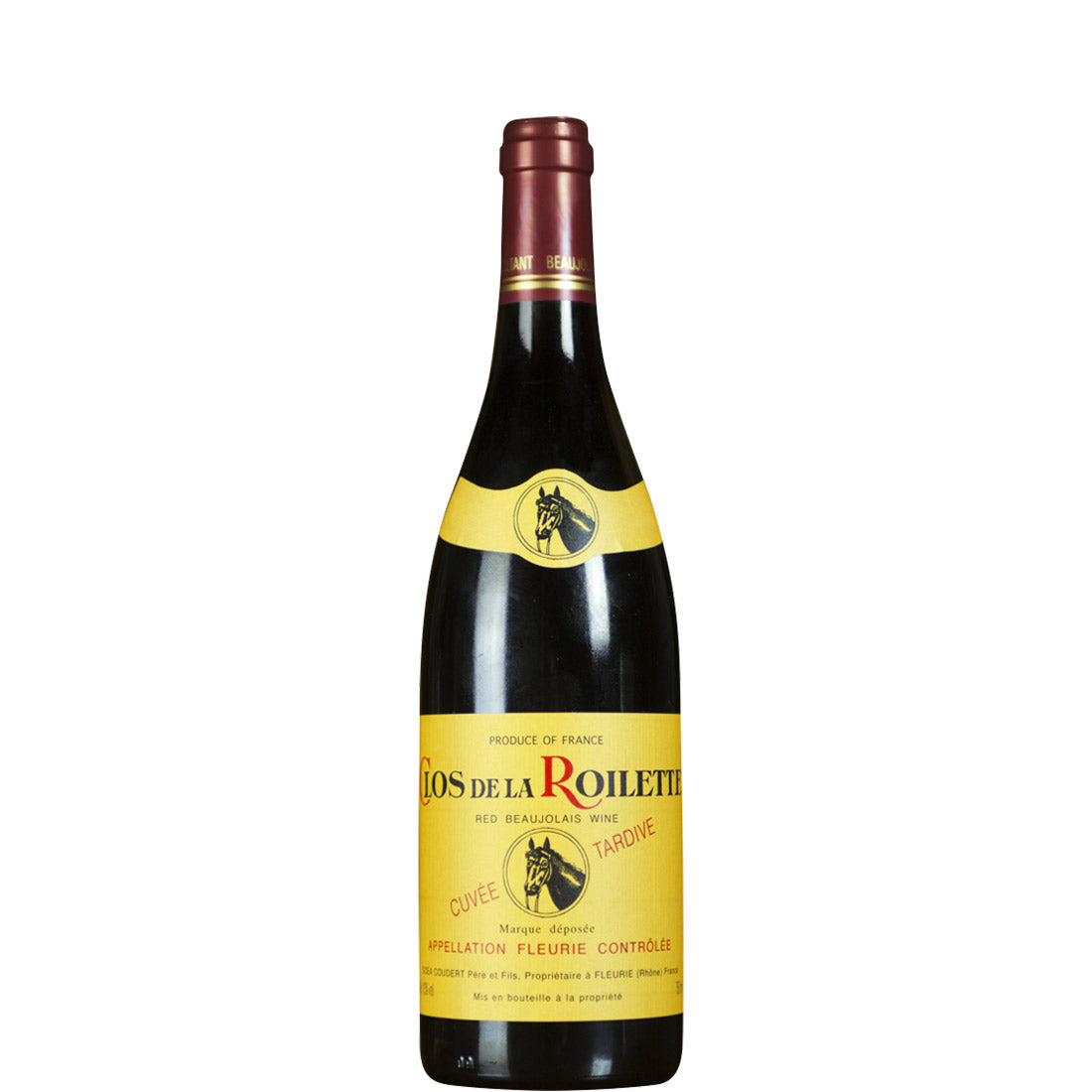
Clos De La Roilette Fleurie Cuvée Tardive, Domaine Coudert, 2020
Clos De La Roilette Fleurie Cuvée Tardive, Domaine Coudert, 2020
- 75cl
- 14%
- Red Still
- Gamay
Couldn't load pickup availability

Optimal drinking window: Now - 2034
The name is a touch misleading — Cuvée Tardive refers not to late harvesting but to the age of the vines, now pushing 90 years old. Domaine Coudert's Clos de la Roilette sits right on the border with Moulin-à-Vent, and that proximity matters: the manganese-rich clay soils here give Gamay a seriousness you simply don't expect from Fleurie. This is not your average gulpable Beaujolais. There's structure here, and genuine complexity that builds with every vintage these ancient vines produce.
The 2020 is generous but focused — red fruits with real mineral tension underneath, and a finish that lingers far longer than the appellation's reputation suggests it should. Unfined and unfiltered, so expect a little sediment, which is exactly as it should be.
In 2026, the 2020 is in a good place — the primary fruit is vivid and the structure is beginning to integrate, making it genuinely enjoyable now. Over the next two to three years, the mineral and earthy secondary notes will come forward and the tannins will soften further, adding another layer of interest. By around 2028-2030 it should be at its most complete, with the old-vine complexity fully expressed and the fruit and structure in ideal balance.
What the critics say:
"A touch darker in the centre and notably more concentrated on the palate. Rich dark raspberry fruit on the palate but extremely moreish. Lots more to give as the tannins soften. Fabulous finish where the strawberries return. At least garriguette quality Drink from 2025-2035. *5/5*"
Tasting Notes
AppearanceDeep ruby with a bright, almost violet-tinged rim — more depth of colour than you'd expect from Gamay.
NoseCrushed red fruits — cherry, raspberry, a suggestion of wild strawberry — with violet and a distinct mineral undercurrent that speaks to those manganese soils. There's a subtle earthiness too, like damp stone, which gives the whole thing a Burgundian gravity.
PalateMore structured than the nose leads you to expect: firm but ripe tannins, good acidity, and a core of dark cherry and bramble fruit. The mineral grip is persistent and very much the point — this is a wine that earns its seriousness.
FinishLong, clean, and savoury, with that stony mineral note carrying through to the end.
Overall impressionOld-vine Gamay at its most convincing — Fleurie in name, but with the bones of something altogether more ambitious.
Food Pairings
In Beaujolais and the wider Lyon area, this style of wine is made for the table rather than the glass alone. Locals would reach for it alongside a classic poulet à la crème, where the wine's acidity cuts through richness without overwhelming the dish. A plateau of charcuterie — rosette de Lyon, saucisson sec, a wedge of rillettes — is the quintessential Beaujolais pairing, and this wine handles it with ease. On cooler evenings, a slow-braised beef cheek or a simple gratin dauphinois would be exactly right. And in the cru villages themselves, you'd often find it on the table with a local cheese like Saint-Marcellin, soft and funky, which the wine's mineral edge handles beautifully.
We think this wine would go well with
Serve at around 14-15°C — cooler than a typical red but warmer than most Beaujolais is served, which allows the structure and complexity to open up properly. A brief decant of 20-30 minutes will help if drinking young, or simply pour and let it breathe in the glass. Given the wine is unfined and unfiltered, stand the bottle upright for an hour before opening to let any sediment settle, and pour carefully. A standard Burgundy-shaped glass works well, giving enough room for the aromas to gather.
The Clos de la Roilette vineyard occupies a privileged position on the southern edge of Fleurie, immediately adjacent to the Moulin-à-Vent appellation boundary. The soils are manganese-rich clay, which is unusual for Fleurie and more characteristic of Moulin-à-Vent — this is why the wine carries more grip and structure than most Fleurie. The vines in the Cuvée Tardive parcel are approaching 90 years old, their deep root systems drawing from the mineral-rich subsoil in a way younger plantings simply cannot. The result is a concentration and complexity that sets this wine apart from its neighbours.
Fleurie is one of the ten Beaujolais crus, widely regarded as among the most elegant and aromatic of the group — 'the queen of Beaujolais,' as it's often called, though Clos de la Roilette reminds you that queens can have real backbone too. The appellation sits in the northern part of Beaujolais, where granite-based soils tend to produce lighter, more perfumed wines than those to the south. Fleurie borders Moulin-à-Vent to the north and east, and where the two meet, the soil changes subtly — and so does the character of the wine. All Beaujolais cru wines are made from Gamay Noir, and unlike Beaujolais Nouveau, cru wines are built to age.
The 2020 vintage in Beaujolais tells the story of a season that started with promise and delivered handsomely. Spring arrived early and stayed dry, setting the vines up for healthy flowering, whilst summer brought enough warmth without the punishing heat that can strip Gamay of its trademark freshness. The harvest kicked off in late August under ideal conditions, with producers picking ripe, healthy fruit that had retained excellent natural acidity.
What landed in the cellars was textbook Beaujolais: vibrant, pure-fruited wines with that irresistible combination of juicy approachability and underlying structure. The Cru Beaujolais from 2020 show particular promise, displaying the mineral backbone that comes from a vintage where the vines didn't have to struggle through drought or diluting rains. These wines are drinking beautifully now, offering immediate pleasure whilst the better examples will reward patience until 2028. We find the village wines and Beaujolais-Villages especially charming this year, capturing everything we love about Gamay at its most exuberant.
FAQs
What does Cuvée Tardive actually mean — is this a late-harvest wine?
Not at all, which is one of the things that makes it interesting. Tardive here refers to the age of the vines rather than late picking — these are nearly 90-year-old Gamay vines, and the name nods to the idea that their best expression comes later in their long lives. No botrytis, no extra sweetness — just old vines doing remarkable things.
What does this wine taste like?
Think vivid red fruits — cherry, raspberry, a little wild strawberry — with violet and a distinct stony, mineral quality that comes from the manganese-rich clay soils. There's real structure here: firm tannins and good acidity that set it well apart from everyday Beaujolais. The finish is long and savoury.
When should I drink it?
It's drinking well now and will continue to do so until around 2034. If you can sit on a few bottles until 2028-2030, we think that's when it will be at its most complete — the fruit and the mineral structure in ideal balance. Don't push too far beyond that.
Is this really comparable to Burgundy?
We wouldn't say it tastes identical, but the structural similarity is genuine — particularly to village-level Burgundy. The old vines, the mineral soils bordering Moulin-à-Vent, and the hands-off winemaking all contribute to a depth and seriousness that punches well above the Fleurie price point. If your Burgundy budget has been squeezed, this is a very good place to look.
What food should I serve with it?
Charcuterie is the classic move — saucisson, rillettes, a good pâté. Beyond that, roast chicken, slow-braised pork, or a soft, funky cheese like Saint-Marcellin all work very well. The wine's acidity and mineral grip make it flexible at the table.
Does the sediment mean something has gone wrong?
Absolutely not. The wine is bottled without fining or filtration, which means a small natural sediment may appear — it's a sign of minimal intervention, not a fault. Stand the bottle upright for an hour before serving and pour carefully, leaving the last centimetre or so in the bottle if sediment has gathered there.

OUR GROWERS
Domaine Coudert
Explore related wines


What are you looking for tonight? Tell me the occasion, a grape, a region — or just try a suggestion below.
Your recommendations will appear here.
-
-
Speak to one of our Wine Gurus
Speak to a Wine GuruWith years of experience, our team can help you with all your wine buying and selling needs