

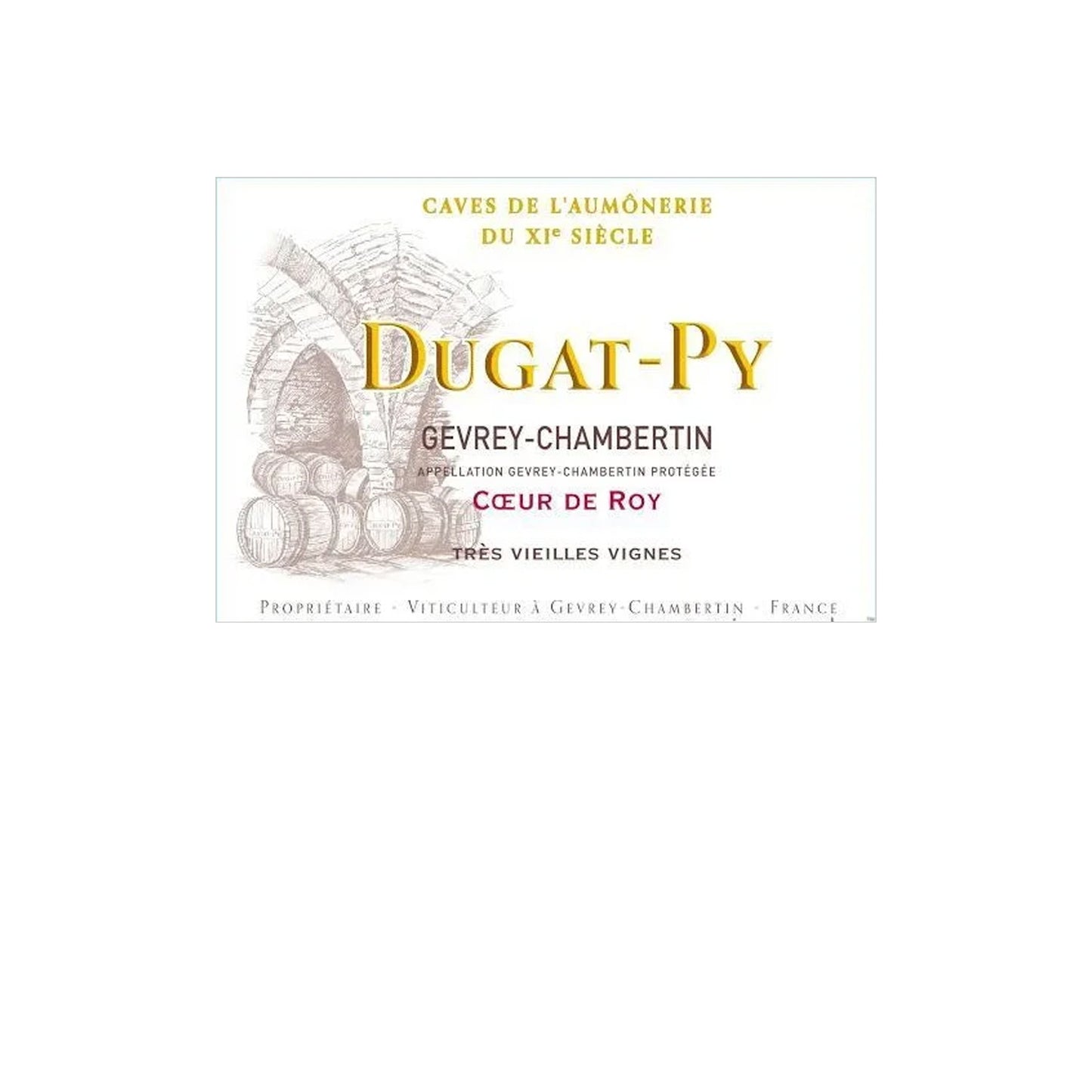
Gevrey-Chambertin 'Coeur de Roy' Très Vieilles Vignes, Domaine Dugat-Py, 2020
Gevrey-Chambertin 'Coeur de Roy' Très Vieilles Vignes, Domaine Dugat-Py, 2020
- 75cl
- 13%
- Red Still
- Pinot Noir
- Organic
- Biodynamic
Couldn't load pickup availability

Optimal drinking window: 2027 - 2050
"Really elegant but penetrating, high-toned nose, pure and crystalline, but velvety red berries, orange peel and autumnal air over white stones. Satisfying succulence and concentration, centred on a stony core - a mineral monolith around which red cherries and red plums dance, tightly wound, and with well delineated tannins drawing the stones and fruit to an extended finish."
Tom Harrow, Head Wine Guru
Loïc Dugat, now 13th generation, is continuing the family tradition of making some of the greatest and most sought-after wines in Burgundy, from the family’s eleven hectares of perfectly-sited vineyards, planted with vines averaging nearly seventy years old. Everything is done by hand, while a horse is used to plough a few of the vineyards. The domaine has been fully organic since 2003, with Loïc now working biodynamically across a number of sites.
The wines are vinified with as little intervention as possible and are bottled unfined and unfiltered. Since 2017 the use of new oak has been reduced which really allows the quality of these sites and the character of the old vine fruit to shine through from barrel. Under Loic’s stewardship and with a string of superb vintages, Dugat-Py is now firmly back in the front rank of Burgundy’s top domaines.
In 2026, the 2020 is drinking with surprising accessibility for its age — the suaveness of the vintage and Loïc's lighter élevage hand have made it approachable earlier than some Dugat-Py releases. That said, the mineral core and the density of old-vine fruit mean there is considerably more to give. We would expect the primary red fruit to begin integrating into more complex secondary notes — forest floor, dried rose, iron — from around 2028 onwards. The wine will likely reach a plateau of real complexity somewhere between 2030 and 2038, before the fruit slowly begins to recede. Drink with pleasure now, but if you can hold bottles until 2030, you will be rewarded.
What the critics say:
"The 2020 Gevrey-Chambertin Coeur du Roy is also a notable success, unfurling in the glass with aromas of dark wild berries, spices, licorice and loamy soil. Full-bodied, ample and layered, it's as concentrated as ever, with striking depth and mid-palate volume, but it's also especially seamless and suave this year, reflecting Loïc Dugat-Py's shift toward gentler winemaking and more discreet élevage."
Tasting Notes
AppearanceDeep, clear ruby with a bright garnet edge and real luminosity in the glass.
NoseHigh-toned and crystalline, with red cherry, wild dark berry and a lift of orange peel over white stones and loamy earth. There is a spice note — something between clove and dried herb — that surfaces as the wine opens up, along with a faint autumnal air that speaks directly to the age of the vines.
PalateFull-bodied but seamless, with the concentration you expect from these old vines wrapped in a suaveness that marks Loïc's gentler winemaking hand. Red cherries and plums circle a stony mineral core that feels structural rather than austere, and the tannins are finely drawn rather than imposing — present, purposeful, and very well integrated for a 2020.
FinishLong and precise, with the stone and fruit pulling together into something that lingers well past the last sip.
Overall impressionA wine of real depth and composure — the old vines doing the heavy lifting, Loïc getting out of the way.
Food Pairings
In Burgundy, a village Gevrey of this calibre would most naturally find itself beside a coq au vin made with — ideally — the same wine, slow-cooked until the sauce is almost lacquer-dark and deeply savoury. Boeuf bourguignon is the other obvious candidate, the braised richness and the wine's mineral grip making each other better. Locally, you might also see it paired with époisses, the famously pungent washed-rind cheese from nearby Époisses, which the wine's structure handles with surprising ease. A roast guinea fowl with wild mushrooms and thyme would be a subtler, perhaps more revealing pairing — the earthiness of the dish drawing out the wine's autumnal complexity.
We think this wine would go well with
Serve at around 16°C — slightly cooler than you might think, which keeps the fruit bright and the mineral edge sharp. A 30-minute decant is worth doing in 2026, more to open the nose than to soften the tannins, which are already well-knit. A large-bowled Burgundy glass gives the wine the space to unfurl properly. If you are opening a bottle now, give it at least an hour in the glass and watch it evolve.
The Coeur de Roy lieu-dit sits on the classic Gevrey limestone-and-clay soils, with the calcium-rich bedrock that gives the village its characteristic stony, mineral grip. Vines averaging close to seventy years old send roots deep enough to tap into the subsoil directly, which is why the wines carry that mineral monolith quality rather than simply ripe fruit. The slightly elevated position and easterly aspect moderate yields naturally and concentrate flavour over a long growing season. Gevrey's relatively continental climate means warm summers can build real richness, but the elevation and old vine stress keep everything focused.
Gevrey-Chambertin is the largest and arguably most celebrated commune in the Côte de Nuits, home to nine Grands Crus including Chambertin itself. Village-level Gevrey can vary enormously depending on who made it and where the vines sit, which is exactly why lieux-dits like Coeur de Roy matter — they give address and accountability to what might otherwise be a sprawling appellation. Compared to neighbours like Morey-Saint-Denis or Chambolle-Musigny, Gevrey tends toward more structure and darker-fruited grip, though the best examples — particularly from old vines — combine that power with a precision that stops well short of heaviness. The AOC rules require 100% Pinot Noir for red wines.
We'll be honest: 2020 in Burgundy was a vintage that kept everyone on their toes. A warm, dry spring brought early budbreak, then summer turned properly scorching with temperatures hitting 40°C in August. The saving grace came from perfectly timed August rains that rescued the vines from serious drought stress, followed by ideal September weather that allowed for unhurried picking. Yields were mercifully normal after several years of frost-ravaged harvests, and crucially, the heat never tipped into the jammy territory that can plague warmer vintages here.
What emerged were wines with surprising freshness despite the heat, showing ripe fruit balanced by good acidity and lovely mineral precision. The reds have more immediate charm than the structured 2019s, with silky tannins and generous Pinot Noir character, whilst the whites display beautiful richness without losing that crystalline Burgundian tension we adore. This isn't a legendary vintage like 2005 or 2010, but it's thoroughly delicious and more approachable in youth than many Burgundy vintages. The village wines are drinking beautifully now, Premier Crus are just hitting their stride, and the Grands Crus will reward patience for another five to ten years.
FAQs
What does Dugat-Py's Coeur de Roy taste like?
Red cherry and wild dark berry around a stony mineral core, with a lift of orange peel and dried spice on the nose. The palate is full-bodied but unusually seamless for the vintage, with finely drawn tannins and a long, precise finish. It is a wine of concentration and composure in equal measure.
When should I drink this?
It is genuinely enjoyable now — the 2020 vintage and Loïc's lighter winemaking have made it approachable earlier than many Dugat-Py releases. But it will reward patience. We would say the sweet spot is somewhere between 2028 and 2038, with the wine at or near its peak around 2030 to 2035.
Is it worth cellaring?
Very much so. The old-vine concentration and the limestone mineral structure give this real ageing potential. If you have the storage, hold at least half your bottles and open the first around 2029 or 2030 — you will find a more complex, secondary character starting to emerge.
What food should I serve with this?
Classic Burgundian matches work best: coq au vin, boeuf bourguignon, roast guinea fowl with wild mushrooms, or a well-aged hard cheese. If you want to go local and adventurous, try it with époisses — the wine's structure handles the pungency surprisingly well.
How should I serve it?
Around 16°C, in a large-bowled Burgundy glass. A 30-minute decant helps open the nose in 2026, though the tannins are already well-integrated. Give it time in the glass and watch it evolve over the course of an evening.
Why does Coeur de Roy matter within the Dugat-Py range?
It is made from très vieilles vignes — very old vines, averaging close to seventy years — within the Coeur de Roy lieu-dit in Gevrey-Chambertin. That old-vine depth, combined with fully organic and increasingly biodynamic farming and minimal intervention in the cellar, is what separates it from standard village Gevrey. It sits just below the Premier Cru level in terms of classification but often punches above that weight in character.

Explore related wines


What are you looking for tonight? Tell me the occasion, a grape, a region — or just try a suggestion below.
Your recommendations will appear here.
-
-
Speak to one of our Wine Gurus
Speak to a Wine GuruWith years of experience, our team can help you with all your wine buying and selling needs